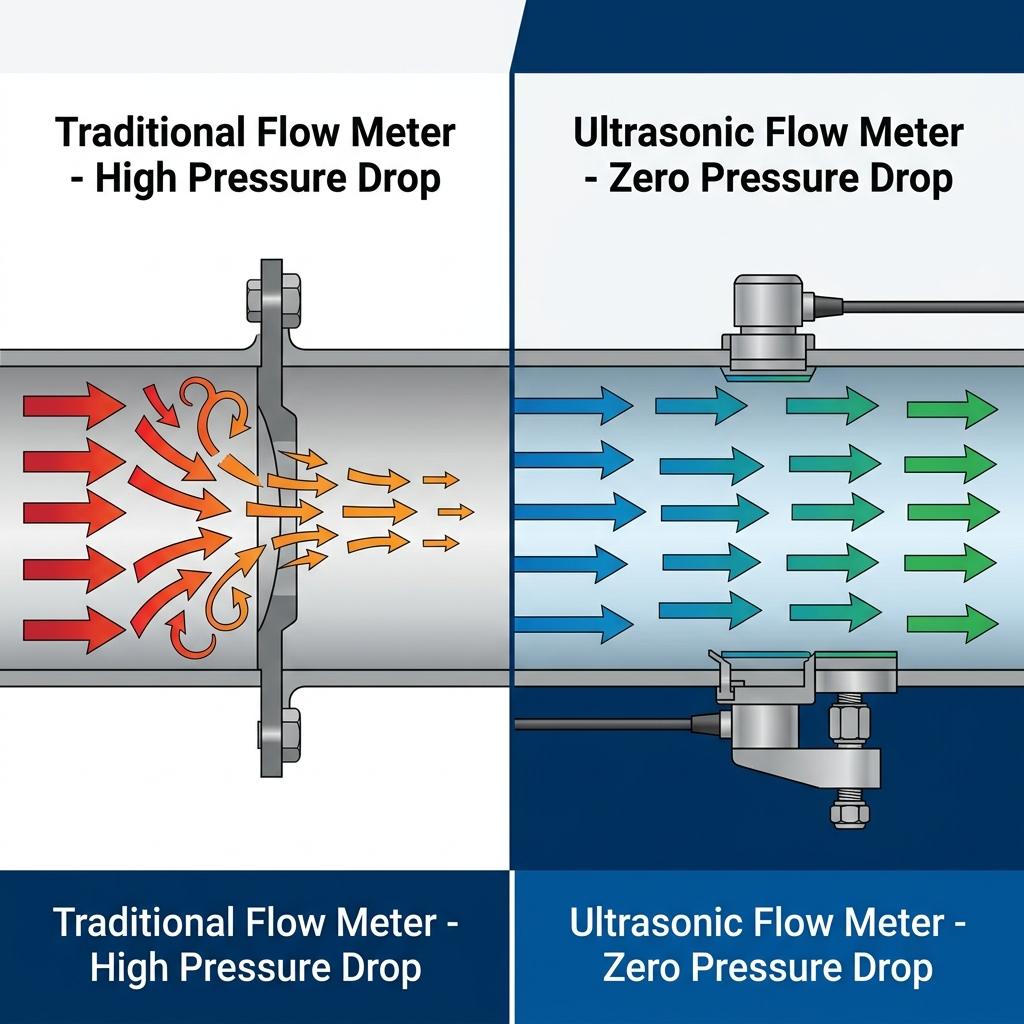
Every flow meter installed in a pipeline acts as a potential bottleneck. Orifice plates choke the flow. Turbine blades spin against the current. Vortex generators force the fluid around a bluff body. All of these create pressure drop — permanent energy that your pumps must work harder to replace.
Ultrasonic flow meters are different. Because they measure flow velocity using sound waves rather than mechanical obstructions, they cause virtually zero pressure drop. In our experience commissioning metering stations across chemical plants, water treatment facilities, and HVAC systems, switching from an orifice plate to a clamp-on ultrasonic meter has eliminated measurable pressure loss entirely — and based on typical industrial scenarios, this can translate to over $20,000 in annual pumping energy savings on multi-loop systems.
Quick Answer: Ultrasonic flow meters — especially clamp-on models — produce zero or negligible pressure drop because they use acoustic signals to measure flow velocity without placing any obstruction inside the pipe. This makes them the most energy-efficient flow measurement technology available.
If you’re unfamiliar with how these meters work, our complete guide to ultrasonic flow meter technology covers the fundamentals.
What Is Pressure Drop in a Flow Meter?
Pressure drop (also called pressure loss or head loss) is the irreversible reduction in static pressure that occurs when fluid passes through a device or fitting in a pipeline. According to Bernoulli’s principle, energy in a flowing fluid is conserved — so any energy consumed by friction, turbulence, or obstruction within a flow meter is permanently lost as heat, resulting in lower downstream pressure.
In practical terms, pressure drop is the price you pay for measuring flow. The greater the obstruction inside the meter, the higher the energy penalty.
Three primary mechanisms cause pressure drop in flow meters:
- Mechanical obstruction — Physical elements like orifice plates, turbine rotors, or vortex-shedding bluff bodies force the fluid to squeeze through narrow passages or push against moving parts.
- Viscous friction — Fluid molecules shear against internal meter surfaces and against each other, converting kinetic energy into heat. This effect intensifies with higher viscosity fluids and faster flow velocities.
- Flow state changes — Sudden acceleration, deceleration, or direction changes (such as fluid passing through a sharp-edged orifice) create turbulent eddies that dissipate additional energy.
Note: Pressure drop is not the same as differential pressure. Differential pressure is a measurement signal — the intentional pressure difference used by DP flow meters to calculate flow rate. Pressure drop is a permanent energy loss — an undesirable side effect. For a deeper dive into this distinction, see our article on flow meter pressure drop fundamentals.
Why Ultrasonic Flow Meters Have Zero Pressure Drop
Ultrasonic flow meters fundamentally eliminate all three causes of pressure drop:
No Mechanical Obstruction
Transit-time ultrasonic meters work by sending ultrasonic pulses diagonally across the pipe — one pulse travels with the flow, the other against it. The time difference between these two signals is directly proportional to fluid velocity. This entire measurement happens through sound propagation; no physical element contacts or obstructs the fluid.
Clamp-on models take this one step further: the transducers mount on the outside of the pipe wall. The ultrasonic signal passes through the pipe wall, through the fluid, and back — without ever penetrating the process boundary. The pipe’s internal geometry remains completely unchanged.
No Added Friction
Because there are no internal wetted parts, blades, rotors, or constrictions, there is no additional friction surface for the fluid to interact with. The meter effectively “doesn’t exist” from a fluid dynamics perspective.
No Flow Disturbance
Ultrasonic signals propagate through the fluid without affecting flow patterns. Unlike vortex meters (which deliberately create Kármán vortex streets behind a bluff body) or turbine meters (which convert fluid energy into rotational energy), ultrasonic meters are entirely passive observers.
Pressure Drop Comparison: Ultrasonic vs. Other Flow Meter Types
The following table compares typical pressure drop values across six common flow meter technologies, measured at nominal flow rate on a DN100 (4-inch) water line at 20°C:
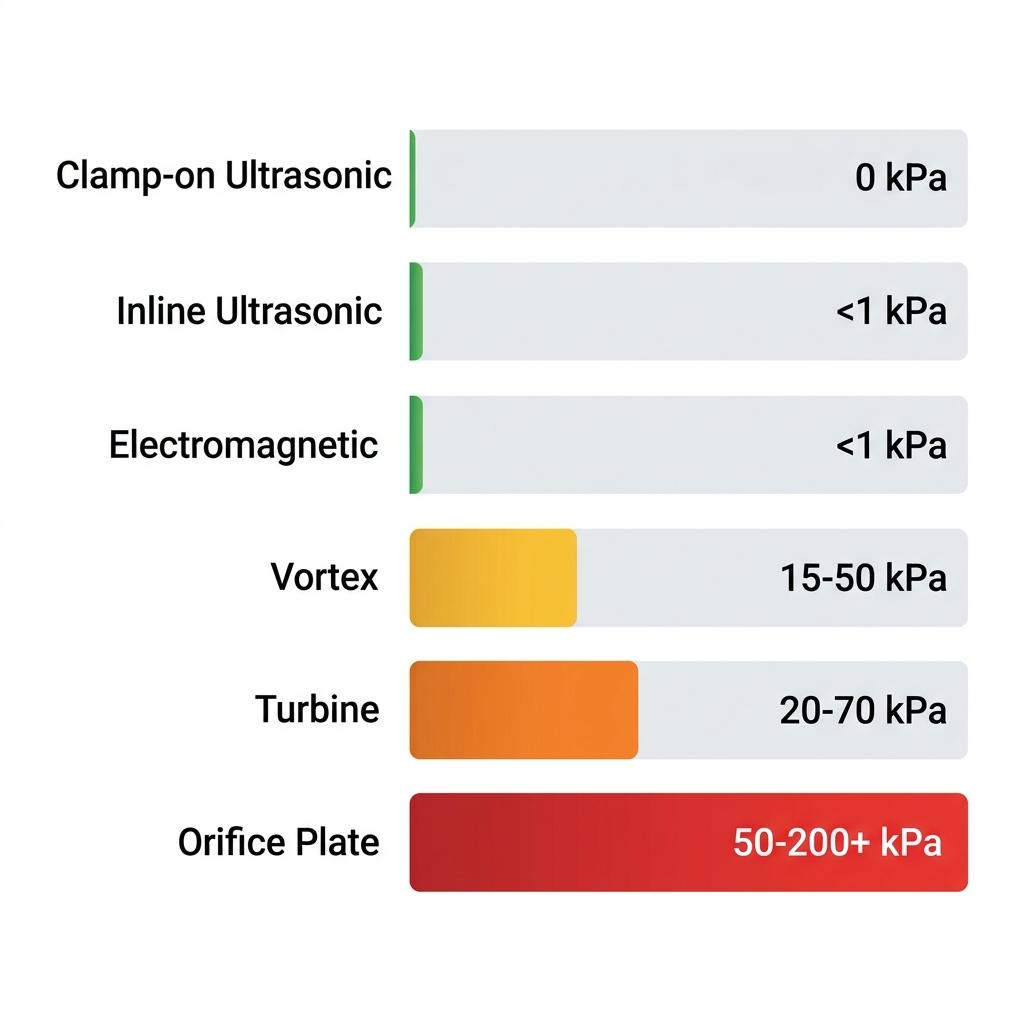
| Flow Meter Type | Typical Pressure Drop | Obstruction Type | Energy Impact |
|---|---|---|---|
| Clamp-on Ultrasonic | 0 kPa (0 psi) | None — external sensors | ✅ Zero energy loss |
| Inline Ultrasonic | < 1 kPa (< 0.15 psi) | Smooth bore, no obstruction | ✅ Negligible |
| Electromagnetic | < 1 kPa (< 0.15 psi) | Smooth bore, electrodes flush | ✅ Negligible |
| Vortex | 15–50 kPa (2.2–7.3 psi) | Bluff body vortex generator | ⚠️ Moderate |
| Turbine | 20–70 kPa (2.9–10.2 psi) | Rotating blades/rotor | ⚠️ Moderate to High |
| Orifice Plate (DP) | 50–200+ kPa (7.3–29+ psi) | Sharp-edged restriction | ❌ High (up to 60-80% permanent loss) |
Key Insight: Orifice plates can cause permanent pressure losses equal to 60-80% of the measured differential pressure. On large-diameter, high-flow systems, this translates directly into thousands of dollars in wasted pumping energy per year. For comparison, see how vortex flowmeter pressure drop and magnetic flow meter pressure drop compare.
Clamp-On vs. Inline vs. Insertion: Pressure Drop Differences
Not all ultrasonic flow meters are created equal when it comes to pressure drop. Here’s how the three main installation types compare:
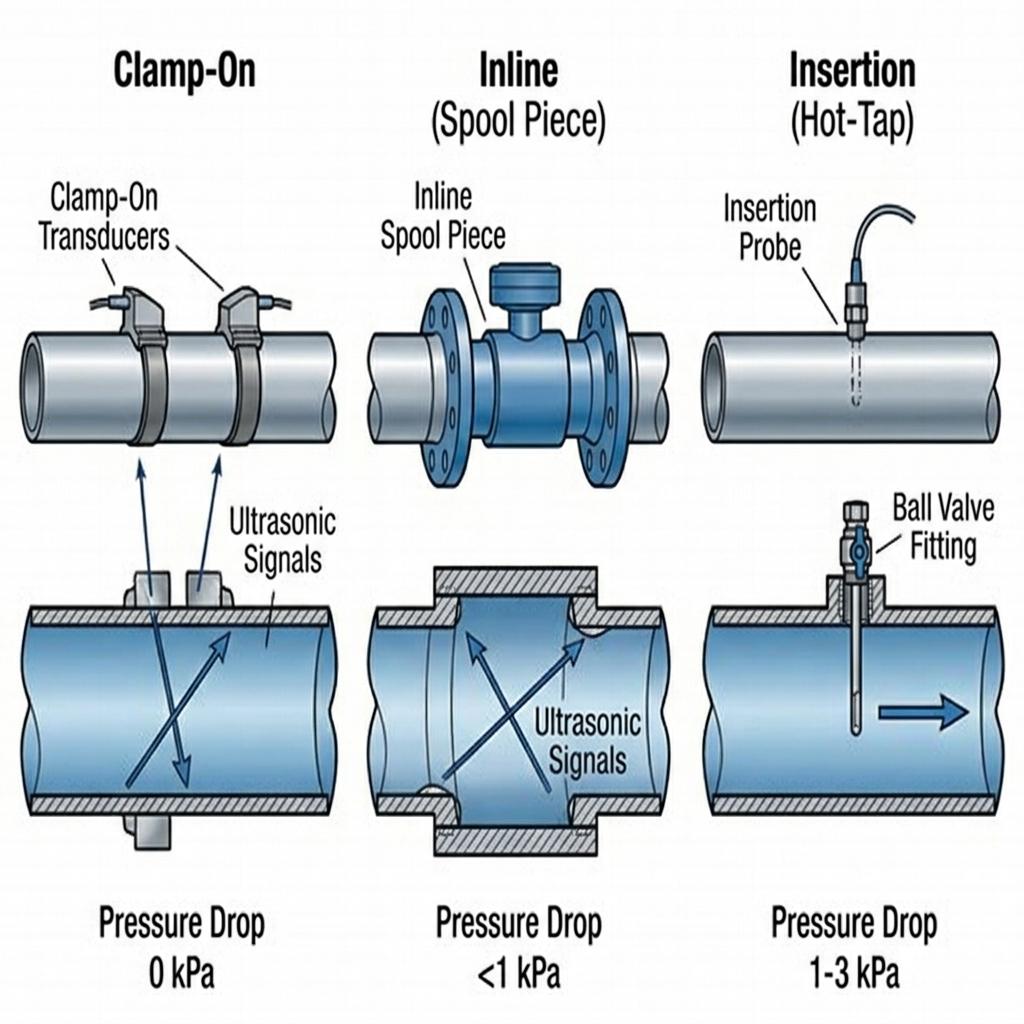
| Installation Type | Pressure Drop | Why |
|---|---|---|
| Clamp-On | Exactly 0 | Transducers mount externally; pipe interior is completely untouched |
| Inline (spool-piece) | Near 0 (< 1 kPa) | Meter body has a smooth bore matching the pipe ID; minor losses from gaskets/flanges only |
| Insertion (hot-tap) | Very low (1–3 kPa) | Small probe extends into the flow; creates minimal local turbulence around the probe tip |
For applications where zero pressure drop is absolutely critical — such as gravity-fed systems, low-pressure process lines, or systems where pump capacity is already maxed out — clamp-on ultrasonic meters are the only technology that guarantees literally zero pressure loss.
Our clamp-on ultrasonic flow meter complete guide covers installation methods and application scenarios in detail.
The Real-World Impact: How Much Energy Can You Save?
Industry Scenario: Replacing Orifice Plates with Clamp-On Ultrasonic Meters on a Cooling Loop
To understand the energy impact of pressure drop, consider a typical industrial cooling water system — a scenario we frequently encounter in chemical processing, power generation, and HVAC district energy applications.
Typical Setup:
– Six DN200 (8-inch) cooling water circulation loops
– Each loop metered with a standard orifice plate flow meter
– Design flow rate: ~200 m³/h per loop
– Operation: 24/7 continuous
Estimated Pressure Drop Impact:
A standard orifice plate on a DN200 line at this flow rate typically produces 50–100 kPa (7–15 psi) of permanent pressure drop (the exact value depends on the beta ratio and flow conditions). Taking a mid-range estimate of 75 kPa per meter across six loops, the pumps must continuously overcome an additional ~450 kPa of system resistance — energy that is converted entirely to heat.
Using the hydraulic power formula:
P = (ΔP × Q) / η
Where ΔP = 75 kPa, Q = 200 m³/h (0.056 m³/s), and pump efficiency η = 0.75:
P ≈ 5.6 kW per pump of wasted power — just to push fluid through the orifice plate.
Across six loops running 8,760 hours/year, that’s approximately 294,000 kWh/year of unnecessary electricity consumption. At a typical industrial rate of ¥0.65/kWh, this translates to roughly ¥190,000/year (~$26,000) in avoidable pumping costs.
Replacing the orifice plates with clamp-on ultrasonic meters eliminates this pressure drop entirely — because clamp-on transducers mount on the outside of the pipe and create zero obstruction.
According to the U.S. Department of Energy, optimizing system pressure is one of the most cost-effective strategies for reducing industrial pumping energy consumption. Eliminating unnecessary flow meter pressure drop is a straightforward first step.
Installation Tip: When installing clamp-on transducers on older carbon steel pipes, it’s common to encounter internal scale buildup from years of water deposits. If you notice weaker-than-expected signal strength, try increasing the pipe wall thickness parameter in the meter settings to account for the scale layer (e.g., add 2–4 mm to the nominal wall thickness). This simple adjustment can significantly improve signal quality without any physical intervention.
When Does Pressure Drop Matter Most?
Not every application is equally sensitive to pressure drop. Here are the scenarios where choosing a zero-pressure-drop meter makes the biggest difference:
High-Impact Scenarios
- Gravity-fed systems — No pump to compensate for pressure loss; every kPa of drop reduces flow rate
- Low-pressure process lines (< 100 kPa operating pressure) — Even small pressure drops represent a large percentage of available pressure
- Large-diameter pipes (DN300+) — Pressure drop scales with velocity squared; large pipes at high flows create enormous energy penalties
- 24/7 continuous processes — Energy waste compounds over time; even 5 kPa of unnecessary pressure drop adds up over 8,760 hours/year
- Pumping-cost-sensitive industries — Water utilities, HVAC district energy, chemical processing
Lower-Impact Scenarios
- High-pressure pipelines (> 1 MPa) — Pressure drop from any meter type is a tiny fraction of total system pressure
- Short measurement runs — Temporary or portable flow measurement where long-term energy cost is not a factor
For portable flow verification applications, see our portable ultrasonic flow meter buyer’s guide.
Technical Specifications: Soaring Instrument Ultrasonic Flow Meters
| Parameter | Wall-Mount Clamp-On | Portable Model |
|---|---|---|
| Pressure Drop | 0 kPa | 0 kPa |
| Pipe Size Range | DN15–DN1200 | DN15–DN1200 |
| Flow Velocity Range | ±0.01 m/s to ±12 m/s | ±0.01 m/s to ±12 m/s |
| Accuracy | ±1.0% of reading | ±1.0% of reading |
| Repeatability | 0.2% | 0.2% |
| Outputs | 4-20mA, RS485 Modbus, OCT Pulse | 4-20mA, RS485 Modbus |
| Communication | RS232/RS485 Modbus (HART Optional) | RS485 Modbus |
| Transmitter IP Rating | IP65 | IP54 |
| Transducer IP Rating | IP68 | IP68 |
| Transducer Temp Range | -40°C to 180°C | -40°C to 180°C |
All specifications verified against manufacturer datasheets. For complete product details, visit our ultrasonic flow meter product page.
FAQ: Ultrasonic Flow Meter Pressure Drop
Do clamp-on ultrasonic flow meters cause any pressure drop?
No. Clamp-on ultrasonic flow meters cause exactly zero pressure drop because the transducers mount on the outside of the pipe. No part of the meter contacts the fluid or enters the flow path, so the pipe’s internal geometry remains completely unchanged.
How does ultrasonic flow meter pressure drop compare to electromagnetic flow meters?
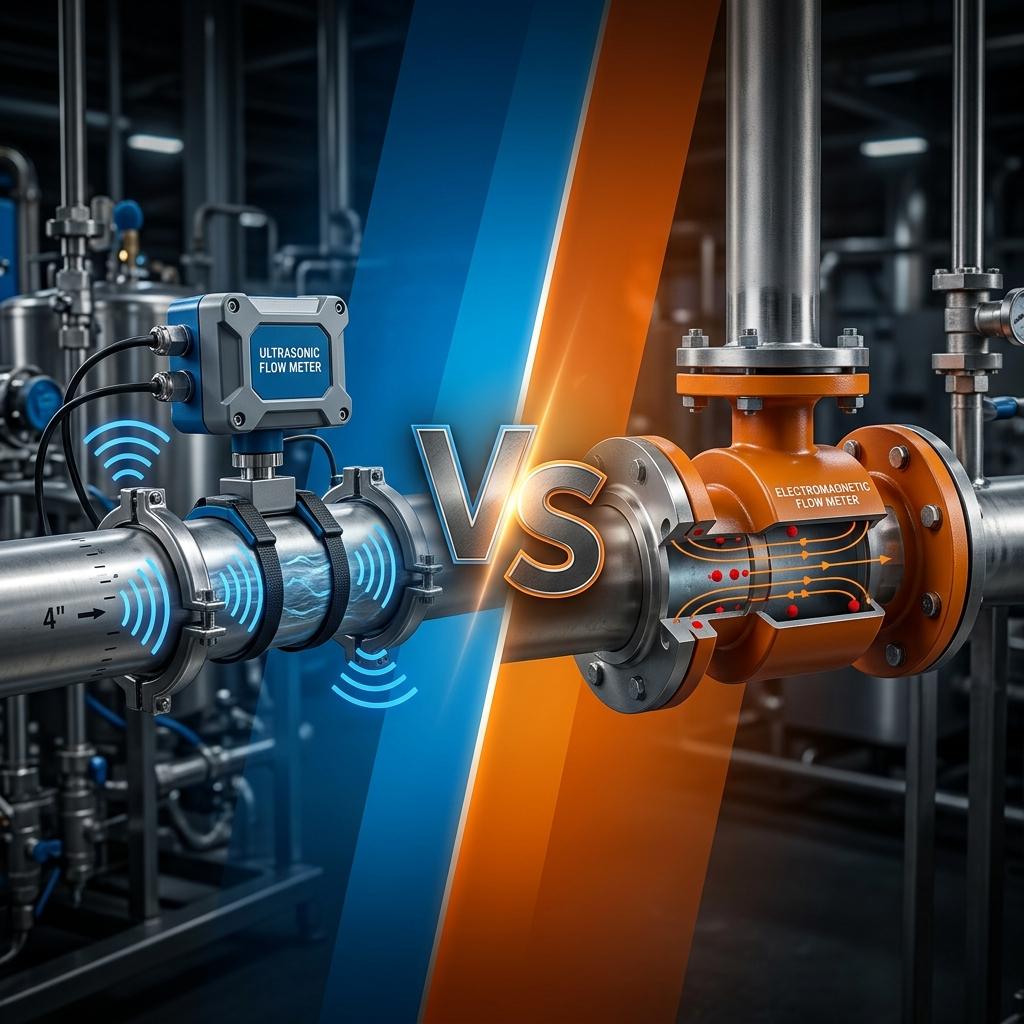
Both technologies produce negligible pressure drop because neither places obstructions in the flow path. However, electromagnetic flow meters require the fluid to be conductive (> 5 μS/cm), while ultrasonic meters work on virtually any liquid. For a detailed comparison, see our ultrasonic vs electromagnetic flow meter guide.
Can pressure drop from a flow meter damage my system?
Excessive pressure drop doesn’t typically cause physical damage, but it can trigger cavitation (the formation and collapse of vapor bubbles) in the fluid downstream of the obstruction. Cavitation erodes pipe walls and meter internals, reduces measurement accuracy, and generates noise and vibration. Ultrasonic meters eliminate this risk entirely.
How much energy can I save by switching to an ultrasonic flow meter?
Energy savings depend on the existing meter’s pressure drop and your system’s flow rate. As a rough guide: replacing an orifice plate causing 75 kPa of pressure drop on a DN200 pipe running at 200 m³/h can save approximately 5.6 kW per pump. On a six-loop system running continuously, this adds up to roughly 294,000 kWh/year — or approximately ¥190,000/year (~$26,000) at typical industrial electricity rates. The payback period for the ultrasonic meter investment is typically 12-18 months.
Does flow velocity affect the pressure drop of an ultrasonic meter?
For clamp-on and inline ultrasonic meters, no — because there is no obstruction, there is no velocity-dependent pressure change. For insertion-type ultrasonic meters, the small probe creates a tiny wake that increases slightly with velocity, but this effect remains below 3 kPa even at maximum rated velocity (12 m/s).
Are there any disadvantages to ultrasonic flow meters despite the zero pressure drop?
Yes. While ultrasonic flow meters have many advantages, they require a clean, homogeneous, single-phase liquid for accurate transit-time measurement. Fluids with heavy suspended solids, excessive air bubbles, or multi-phase conditions can scatter the ultrasonic signal. They also require adequate straight pipe runs upstream and downstream for accurate readings. Learn more in our installation guide.
Conclusion
Pressure drop is an unavoidable consequence of most flow measurement technologies — but not ultrasonic flow meters. By using acoustic signals instead of mechanical obstructions, ultrasonic meters deliver accurate flow measurement with zero permanent pressure loss. This translates directly into:
- Lower pumping energy costs — no wasted energy overcoming meter resistance
- Extended pump and system life — reduced mechanical stress and no cavitation risk
- Zero maintenance for pressure-related issues — no scaling, no clogging, no blade wear
- Compatibility with pressure-sensitive systems — gravity-fed lines, low-pressure processes, and maxed-out pump systems
For engineers and plant managers evaluating flow measurement options, pressure drop should be a key selection criterion — especially in large-diameter, continuous-operation, or energy-cost-sensitive applications.
Need Help Choosing the Right Ultrasonic Flow Meter?
Our engineering team at Soaring Instrument has 15+ years of experience designing and deploying ultrasonic flow measurement solutions across water treatment, chemical processing, HVAC, and oil & gas industries. Whether you need a permanent wall-mount system, a portable verification unit, or a custom solution for challenging pipe conditions, we can help.
👉 Contact our team for a free consultation
📧 Or email us directly at [email protected]
Related Articles
- What Do You Need to Know About Flow Meter Pressure Drop?
- What Is Vortex Flowmeter Pressure Drop?
- Magnetic Flow Meter Pressure Drop: What You Need to Know
- Clamp On Ultrasonic Flow Meter: Complete Guide
- Ultrasonic vs Electromagnetic Flow Meters: Which One Should You Choose?
- How Does an Ultrasonic Flow Meter Work: Understanding the Technology
- What Are the Advantages and Disadvantages of Ultrasonic Flow Meters?
- How to Install a Clamp On Ultrasonic Flow Meter