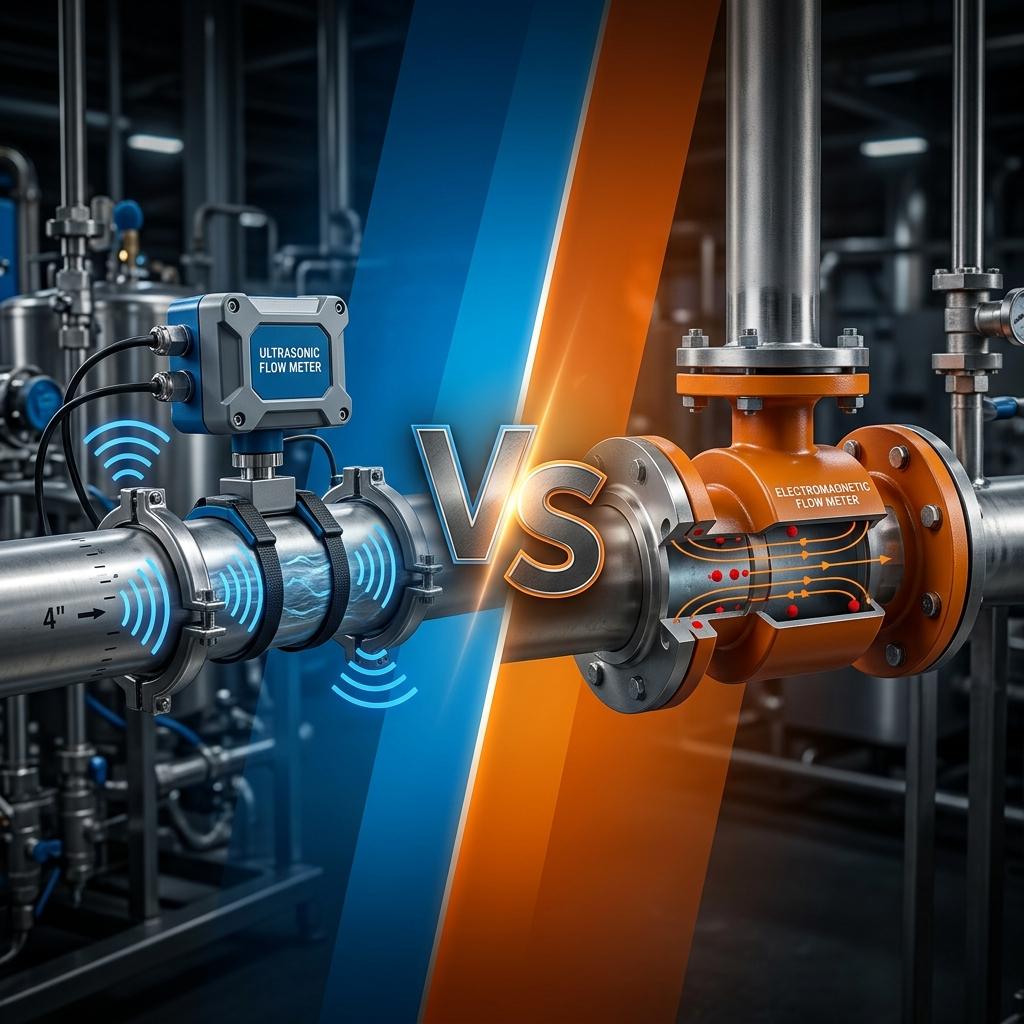
Choosing between an ultrasonic vs electromagnetic flow meter is one of the most common—and most consequential—decisions in industrial flow measurement. Both technologies deliver excellent accuracy with no moving parts, yet they operate on fundamentally different physical principles that make each one ideal for specific applications.
Quick Answer: If your fluid is electrically conductive (≥5 μS/cm) and you can install an inline meter, choose electromagnetic. If your fluid is non-conductive (oils, gases, ultrapure water), you need non-invasive installation, or you cannot shut down the pipeline, choose ultrasonic.
After commissioning hundreds of flow measurement systems across water treatment plants, chemical facilities, and HVAC projects, we’ve learned that the “right” choice depends on just three factors: fluid conductivity, installation constraints, and total cost of ownership. This guide breaks down every technical detail you need to make that decision confidently.
How Ultrasonic Flow Meters Work
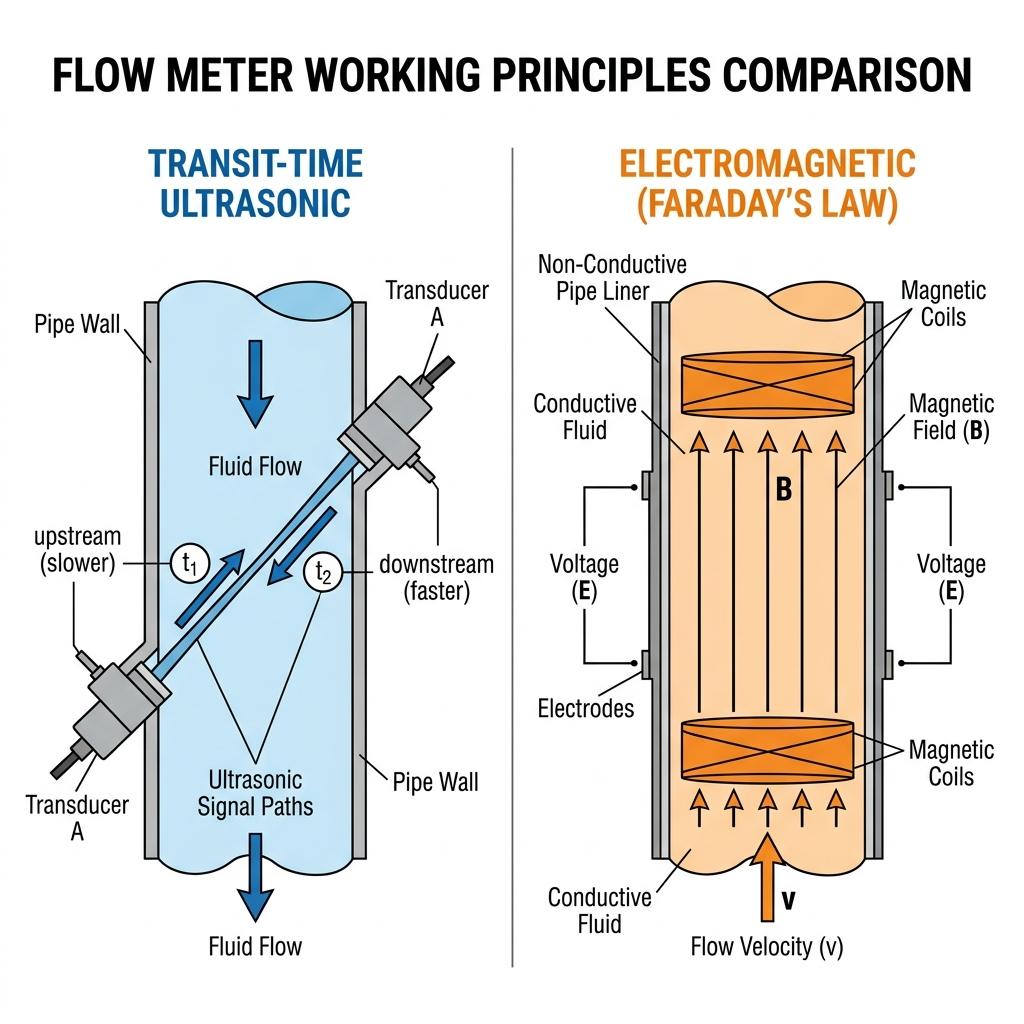
Ultrasonic flow meters use sound waves to determine flow velocity without contacting the fluid. They contain no moving parts, create zero pressure drop, and can be installed as clamp-on (non-invasive) or inline configurations.
Transit-Time Principle
The transit-time method—also called contrapropagating transit-time—is the most common technology for clean liquid applications. Two ultrasonic transducers are mounted at a known angle to the pipe wall. They alternately send frequency-modulated bursts of sound upstream and downstream through the fluid.
The principle is straightforward:
- Sound traveling downstream (with the flow) arrives faster
- Sound traveling upstream (against the flow) arrives slower
- The time difference (Δt) is directly proportional to flow velocity
The mathematical relationship:
v = (L / 2cosα) × (t_up – t_down) / (t_up × t_down)
Where:
- v = average flow velocity along the acoustic path
- L = distance between transducers
- α = angle of the ultrasonic beam relative to flow direction
- t_up, t_down = transit times in each direction
The speed of sound (c) can also be calculated from the absolute transit times, which is why these meters are sometimes affected by temperature, density, and acoustic properties of the fluid.
Key advantage: Transit-time meters work best with clean liquids having minimal suspended particulates (typically <2-3% solids by volume). The signal processing algorithms require a clean acoustic path between transducers.
Doppler Principle
Doppler ultrasonic meters work on the opposite principle—they require suspended particles or gas bubbles in the fluid. A transmitted ultrasonic signal reflects off these particles, and the frequency shift (Doppler effect) between the transmitted and reflected signals is proportional to the velocity of the particles.
Doppler meters are generally less accurate than transit-time models (typically ±2-5%) but excel in “dirty” applications like slurries, mining tailings, or wastewater with high solids content.
In our experience: We typically recommend transit-time technology for 90%+ of applications. Doppler meters fill a niche for very dirty fluids where transit-time signals cannot penetrate, but for most industrial liquids, transit-time delivers superior accuracy.
How Electromagnetic Flow Meters Work
Electromagnetic flow meters (also called mag meters or magnetic flow meters) operate on Faraday’s law of electromagnetic induction—the same principle that drives electric generators.
Faraday’s Law of Electromagnetic Induction
When a conductive liquid flows through a magnetic field, it generates a voltage perpendicular to both the flow direction and the magnetic field. This induced voltage is directly proportional to the flow velocity:
E = k × B × D × v
Where:
- E = induced voltage (detected by electrodes)
- k = calibration constant
- B = magnetic field strength (generated by magnetic coils)
- D = pipe diameter
- v = average flow velocity
Two electrodes embedded in the pipe wall detect this tiny voltage (typically in the microvolt range), which is then amplified through signal processing circuits to calculate flow rate and volume flow.
The beauty of this principle: the measurement is completely independent of fluid temperature, pressure, density, and viscosity. As long as the fluid is conductive, the reading is linear and highly stable.
The Conductivity Requirement: Why It Matters
Here’s the fundamental limitation of electromagnetic flow meters: the fluid must be electrically conductive. The minimum conductivity requirement is typically ≥5 μS/cm (some advanced meters can go as low as 1 μS/cm).
This means mag meters cannot measure:
- Hydrocarbons (oils, fuels, solvents) — conductivity ≈ 0
- Distilled/deionized/ultrapure water — conductivity < 1 μS/cm
- Gases of any type
- Most organic solvents
This single limitation is often the deciding factor. If your fluid is non-conductive, the decision is already made: you need an ultrasonic meter. For a detailed analysis of this topic, see our guide on why mag meters can’t measure ultrapure water.
Practical note: In our field experience, we’ve seen engineers mistakenly specify mag meters for demineralized water in power plants. The conductivity drops below 1 μS/cm after the polishing unit, causing unstable readings, signal noise, and empty pipe detection false alarms. Always verify fluid conductivity before specifying.
Head-to-Head Comparison: 8 Key Factors
This is the comparison table that every engineer needs but no single competitor provides with real numbers. Here’s our comprehensive breakdown based on actual product specifications:
| Factor | Ultrasonic (Clamp-On) | Electromagnetic (Inline) |
|---|---|---|
| Accuracy | ±1.0% of reading | ±0.5% (±0.2% optional) |
| Repeatability | 0.2% | 0.1% |
| Turndown Ratio | 100:1 | 150:1 |
| Fluid Requirement | Any liquid (clean, minimal particles) | Conductive liquid only (≥5 μS/cm) |
| Pipe Size Range | DN15–DN5000 | DN3–DN3000 |
| Temperature Range | -40°C to 180°C (transducer dependent) | -40°C to 180°C |
| Pressure Rating | Unlimited (non-contact) | Up to 42 MPa |
| Installation | Non-invasive, no shutdown required | Inline, requires pipe cutting |
| Pressure Drop | Zero | Near zero |
| Moving Parts | None | None |
| Communication | 4-20mA, RS485, Modbus, HART | 4-20mA, RS485, HART, Pulse |
| Protection Class | IP65 (transmitter) / IP68 (sensors) | IP65 / IP68 |
| Typical Lifespan | 15-20 years (electronics) | 20-30 years (no wear parts) |
| Maintenance | Coupling gel check, sensor repositioning | Electrode cleaning, liner inspection |
| Bidirectional | Yes | Yes |
Accuracy & Repeatability
Electromagnetic flow meters win on raw accuracy: ±0.5% standard (±0.2% with custom calibration) vs. ±1.0% for clamp-on ultrasonic. However, this gap narrows significantly with inline ultrasonic meters (spool-piece type), which can achieve ±0.5%.
For most industrial processes, both technologies exceed the required accuracy. The real question is whether you need custody-transfer-grade precision (choose mag) or good-enough accuracy with installation flexibility (choose ultrasonic).
Fluid Compatibility: Conductivity is the Dealbreaker
This is the single most important selection criterion:
- Conductive liquids (tap water, wastewater, acids, caustic solutions, slurries): Both technologies work; mag meter typically preferred for long-term stability
- Non-conductive liquids (oils, hydrocarbons, solvents, ultrapure water): Only ultrasonic works
- Liquids with high solids (>10% by volume): Doppler ultrasonic or mag meter with abrasion-resistant liner
- Gases: Only ultrasonic works (mag meters cannot measure gas)
Installation: Clamp-On vs Inline
This is where ultrasonic meters have an enormous practical advantage:
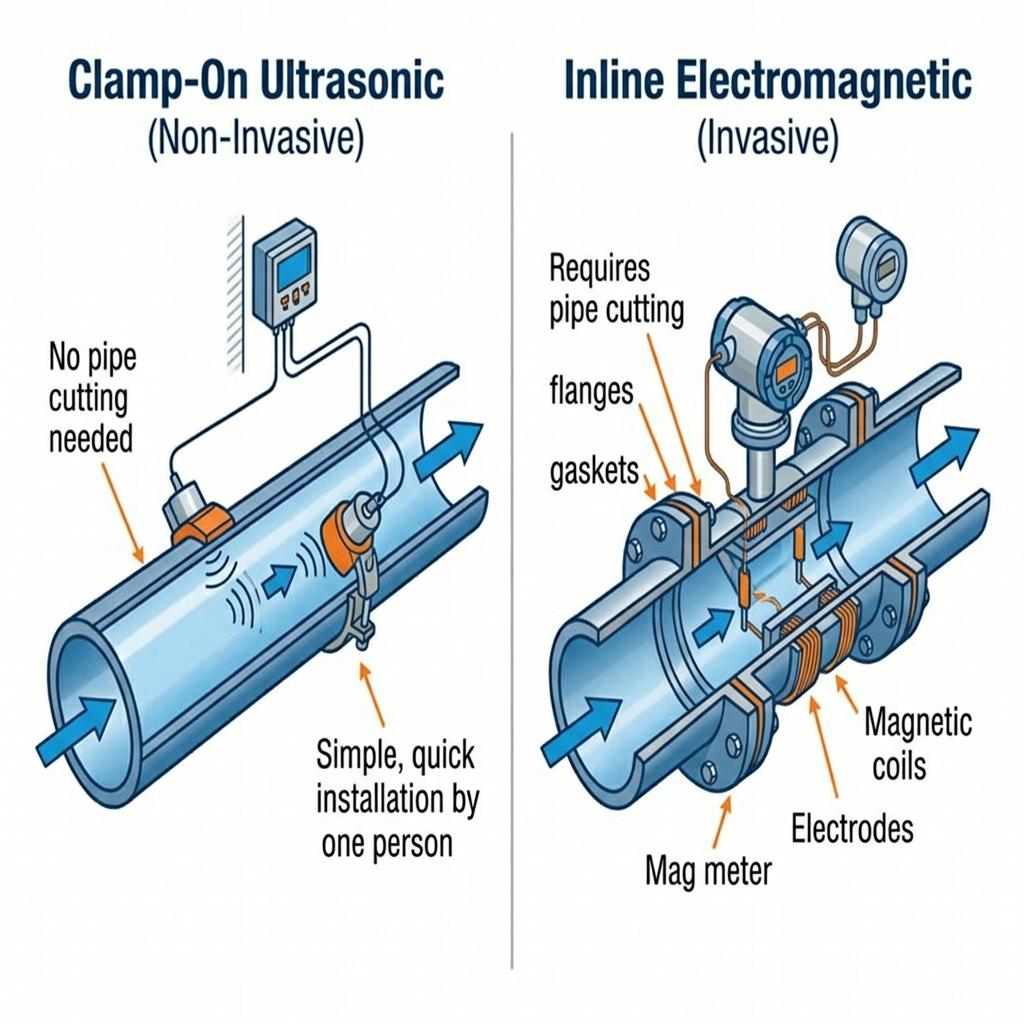
Clamp-on ultrasonic:
- Mount transducers on the outside of the pipe wall
- No pipe cutting, no welding, no process shutdown
- A single technician can install in 30-60 minutes
- Perfect for retrofits, temporary measurements, and verification
- Requires adequate straight run (typically 10D upstream, 5D downstream) to ensure a fully developed velocity profile with stable Reynolds number conditions
Inline electromagnetic:
- Requires cutting the pipe and flanged connections
- Process must be shut down and drained
- Installation typically requires a full crew and 4-8 hours
- Needs proper grounding ring installation on non-conductive pipes
- Also requires straight run for stable velocity profile (typically 5D upstream, 3D downstream)
Lessons from the field: We once helped a district cooling plant that needed flow measurement on a 600mm chilled water main. Shutting down the pipe for mag meter installation would have required draining the entire loop—a 3-day operation affecting multiple buildings. A clamp-on ultrasonic meter was installed in 45 minutes during normal operation with zero downtime.
Maintenance & Long-Term Reliability
Electromagnetic meters are renowned for their “install and forget” reliability. With no moving parts, no obstructions in the flow path, and wetted parts limited to the liner and electrodes, a quality mag meter can run 20-30 years with minimal intervention. Periodic maintenance includes:
- Zero point calibration verification (annually)
- Electrode cleaning (if measuring slurries)
- Liner inspection for abrasion (heavy-duty applications)
Ultrasonic meters also have excellent long-term reliability, but clamp-on installations require:
- Acoustic coupling gel verification (every 6-12 months)
- Sensor positioning check (vibration can shift sensors)
- Pipe condition monitoring (corrosion or scale buildup on inner pipe wall affects signal)
Cost: Purchase Price vs Total Cost of Ownership
| Cost Element | Ultrasonic (Clamp-On) | Electromagnetic |
|---|---|---|
| Meter purchase | $800–$3,500 | $500–$4,000 |
| Installation labor | 1-2 hours, no shutdown | 4-8 hours + shutdown cost |
| Pipe modification | None | Flanges, gaskets, bolts |
| Annual maintenance | $50–$150 | $50–$100 |
| 5-Year TCO (DN100) | ~$2,500–$4,500 | ~$3,000–$6,500 |
The purchase price is often similar, but the total cost of ownership favors clamp-on ultrasonic due to zero installation infrastructure cost and no process downtime. For new installations where pipe work is already planned, mag meters become more cost-competitive.
Pipe Size & Pressure Range
- Ultrasonic covers DN15 to DN5000 (no upper limit for clamp-on, since the meter doesn’t contact the fluid)
- Electromagnetic covers DN3 to DN3000
For very large pipes (>DN1000), clamp-on ultrasonic or insertion-type electromagnetic meters are typically used to avoid the enormous cost and weight of full-bore mag meters.
For pressure: clamp-on ultrasonic has no pressure limitation (it’s on the outside of the pipe). Electromagnetic meters are available up to 42 MPa for high-pressure applications like oil field water injection.
Temperature Tolerance
Both technologies cover similar ranges (-40°C to 180°C), but the details matter:
- Clamp-on transducers use acoustic coupling that degrades above certain temperatures. High-temperature sensors (like our TT02H) extend to 180°C but require special couplant
- Mag meter liner materials limit temperature: PTFE handles up to 180°C, rubber liners typically max at 80°C
Communication & Integration
Both technologies offer modern industrial communication protocols:
| Protocol | Ultrasonic | Electromagnetic |
|---|---|---|
| 4-20mA analog | ✅ | ✅ |
| RS485 Modbus | ✅ | ✅ |
| HART protocol | Optional | Optional |
| Pulse/Frequency | ✅ | ✅ |
| GPRS/Wireless | Optional | Optional |
For SCADA integration, both technologies connect seamlessly. HART protocol is more commonly standard on mag meters due to their widespread use in process industries.
Decision Matrix: Which Flow Meter for Your Application?
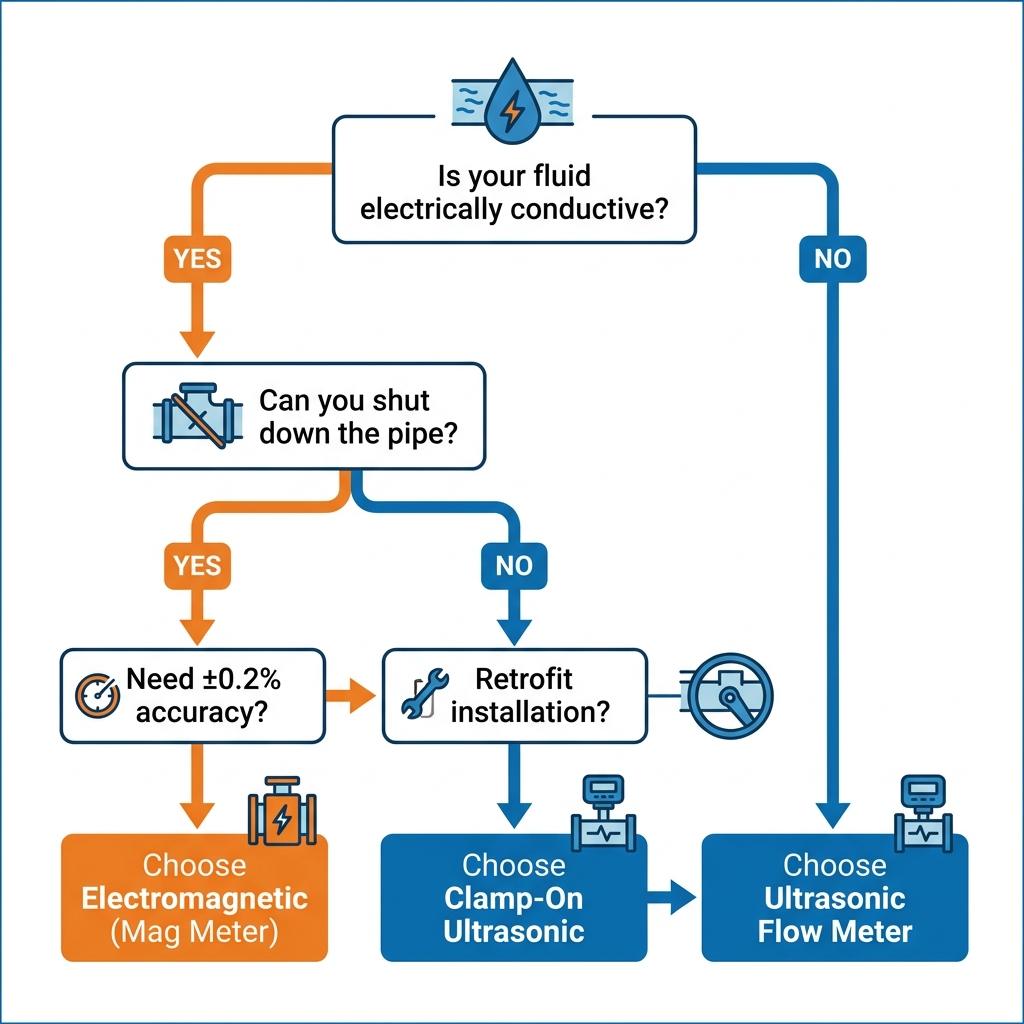
Stop overthinking. Use this decision framework:
Water & Wastewater Treatment → Electromagnetic (Usually)
Municipal water and wastewater treatment plants overwhelmingly use mag meters because:
- Water is conductive (300-800 μS/cm typical)
- Wastewater contains solids/debris that don’t affect mag meters
- Long-term stability is critical for billing and regulatory compliance
- Full pipe condition is maintained in pressurized mains
Exception: Open channels and gravity-fed sewers use ultrasonic (area-velocity or open-channel type).
HVAC & Building Systems → Either (Budget Decides)
For chilled water and heating systems:
- Mag meters provide superior accuracy for energy billing
- Clamp-on ultrasonic meters are preferred for retrofit projects and buildings where pipe shutdown is impractical
- Our ultrasonic models with BTU/energy meter function can directly calculate heating/cooling energy using paired PT1000 temperature sensors
Oil & Gas / Hydrocarbons → Ultrasonic (Only Option)
Crude oil, refined petroleum products, LNG, and natural gas are all non-conductive. Electromagnetic meters simply cannot work here. Transit-time ultrasonic meters are the standard for:
- Custody transfer of hydrocarbons
- Pipeline leak detection (multi-path ultrasonic)
- Flare gas measurement
Chemical Processing → Depends on Conductivity
Chemical plants present the widest variety of fluids:
- Acids and caustics (HCl, NaOH, H₂SO₄): Conductive → Mag meter with appropriate electrode material (Hastelloy C, Titanium, or Platinum)
- Organic solvents (toluene, acetone, methanol): Non-conductive → Ultrasonic
- Pharmaceutical water (WFI, PW): Low conductivity → Ultrasonic or specialized low-conductivity mag meter
Drinking Water → Both Viable (Compare TCO)
Drinking water (typically 200-800 μS/cm) works perfectly with both technologies. The decision often comes down to:
- New pipeline project → Mag meter (best accuracy, lowest long-term maintenance)
- Existing pipeline, no shutdown possible → Clamp-on ultrasonic
- Temporary verification measurement → Portable ultrasonic
Retrofit / Cannot Shut Down → Clamp-On Ultrasonic (No Question)
If you cannot afford process downtime, the answer is always clamp-on ultrasonic. Period. No other technology offers truly non-invasive flow measurement on closed pipes.
Can You Use Both? Hybrid Measurement Strategies
Here’s something none of our competitors discuss: using both technologies together for maximum reliability.
Portable Ultrasonic for Mag Meter Verification
Many industrial facilities install permanent mag meters for continuous monitoring but keep a portable ultrasonic flow meter for periodic verification. This approach:
- Validates mag meter accuracy without removing it from service
- Identifies drift or electrode fouling before it affects process control
- Satisfies ISO audit requirements for measurement verification
- Costs far less than maintaining two permanent meter installations
We supply portable ultrasonic meters with magnetic guiding rails and printed scales specifically for this verification application. A single technician can verify a mag meter reading in under 15 minutes.
Dual Technology Redundancy in Critical Applications
For custody transfer, billing, or safety-critical measurements (e.g., cooling water to a nuclear reactor), some facilities install both an inline mag meter AND a clamp-on ultrasonic as backup. If one technology fails or gives an anomalous reading, the other provides independent verification.
Real-World Case Studies
Case 1: Chemical Plant — Switching from Mag to Ultrasonic
Problem: A specialty chemical manufacturer had mag meters installed on their solvent recovery lines. After a process change introduced a higher-purity solvent (conductivity dropped from 50 μS/cm to 3 μS/cm), the mag meters began showing erratic readings—jumping 20-30% without actual flow changes. The empty pipe detection alarm triggered repeatedly.
Solution: We replaced the mag meters with wall-mounted clamp-on ultrasonic meters (S801 series). Since the solvent was clean and homogeneous, transit-time technology provided stable readings regardless of conductivity.
Result: Flow measurement stability improved from ±20% variation to ±1.5%. The non-contact installation also eliminated the corrosion risk on wetted electrodes that had previously required annual replacement (saving ~$2,000/year per meter in electrode costs).
Case 2: Municipal Water Utility — Using Both Technologies
Problem: A water distribution network needed flow measurement at 35 locations. Budget constraints prevented installing mag meters everywhere, and 8 locations couldn’t be shut down for inline installation.
Solution:
- 27 new-construction points → Standard pipeline electromagnetic flow meters (±0.5% accuracy for billing compliance)
- 8 retrofit points → Wall-mounted clamp-on ultrasonic meters (installed during normal operation)
- 1 portable ultrasonic meter for quarterly verification rounds
Result: Full network coverage achieved within budget. The portable meter identified two mag meters with drifted calibration within the first year—catching errors that would have resulted in ~$45,000 in unbilled water.
Technical Specifications Comparison
Based on actual Soaring Instrument product specifications:
| Specification | Ultrasonic (Clamp-On) | Pipeline Electromagnetic |
|---|---|---|
| Applicable Media | Any liquid (clean to moderately dirty) | Conductive liquid, slurry (≥5 μS/cm) |
| Pipe Diameter | DN15–DN1200 | DN3–DN3000 |
| Accuracy | ±1.0% of reading | ±0.5% (custom ±0.2%) |
| Repeatability | 0.2% | 0.1% |
| Flow Velocity | ±0.01–12 m/s | 0.1–15 m/s |
| Turndown Ratio | 100:1 | 150:1 |
| Medium Temperature | -40°C to 180°C | -40°C to 180°C |
| Working Pressure | No limit (non-contact) | Up to 42 MPa |
| Output | 4-20mA, RS485 Modbus, HART optional | 4-20mA, RS485/HART, Pulse |
| Protection | IP65 (transmitter) / IP68 (sensor) | IP65 / IP68 |
| Explosion-Proof | N/A (external mount) | ExdIIa, ExdII CT6 Gb |
| Power Supply | DC 10-36V / AC 90-245V | 220V AC / 24V DC / 3.6V Li |
| Liner Material | N/A | PTFE, Rubber, PFA |
| Electrode Material | N/A | SUS316, Hastelloy B/C, Ti, Pt |
| Response Time | Adjustable 0.5-60s | ≤1s |
| Data Logger | 32GB TF card (portable model) | 1000 groups internal |
| Energy Meter | Optional BTU with PT1000 | Optional with Pt1000 |
Frequently Asked Questions
Can an ultrasonic flow meter measure conductive liquids?
Yes, absolutely. Ultrasonic flow meters work with both conductive and non-conductive liquids. Conductivity has no effect on ultrasonic measurement since it uses sound waves, not electromagnetic induction. This is why ultrasonic meters are considered more “universal”—they measure a wider range of fluids than any other single technology.
Why can’t electromagnetic flow meters measure oil?
Because electromagnetic flow meters rely on Faraday’s law: a conductive fluid flowing through a magnetic field generates a voltage proportional to velocity. Oil and other hydrocarbons have essentially zero electrical conductivity, so no voltage is generated—the electrodes detect nothing. It’s a fundamental physical limitation, not a design flaw.
Which flow meter is more accurate?
Electromagnetic meters typically offer higher accuracy: ±0.5% standard (±0.2% customized) vs. ±1.0% for clamp-on ultrasonic. However, inline (spool-piece) ultrasonic meters can match mag meter accuracy at ±0.5%. For most industrial applications outside custody transfer, both technologies exceed required accuracy levels.
Can I install a flow meter without shutting down the pipeline?
Yes—this is the defining advantage of clamp-on ultrasonic flow meters. Sensors mount on the exterior of the pipe with no pipe cutting, drilling, or process interruption. Installation takes 30-60 minutes. Electromagnetic meters always require an inline installation with process shutdown.
What is the minimum conductivity for a mag meter?
The standard minimum is 5 μS/cm (microsiemens per centimeter). Some advanced mag meters with specialized electronics can operate down to 1 μS/cm. For reference: tap water is typically 200-800 μS/cm, and demineralized water can be as low as 0.1 μS/cm (too low for any mag meter).
How do I choose between ultrasonic and electromagnetic for drinking water?
Both work excellently for drinking water (conductivity 200-800 μS/cm). Choose based on your situation:
- New installation with planned piping work → Electromagnetic (best accuracy, lowest long-term maintenance)
- Retrofit where you cannot shut down → Clamp-on ultrasonic
- Need to verify existing meters → Portable ultrasonic
For billing/revenue metering, most utilities prefer mag meters for their superior long-term stability and ±0.2% accuracy option.
Which flow meter has lower maintenance costs?
Both technologies have very low maintenance requirements due to having no moving parts. Electromagnetic meters have a slight edge for permanent installations (no coupling gel to check, no sensor repositioning needed). Clamp-on ultrasonic meters require periodic coupling verification but have zero risk of liner degradation or electrode fouling. Over a 10-year period, expect $500-$1,500 total maintenance cost for either technology.
Conclusion
The ultrasonic vs electromagnetic flow meter decision comes down to three fundamental questions:
1. Is your fluid conductive? If no → Ultrasonic is your only option 2. Can you shut down for installation? If no → Clamp-on ultrasonic is your only option 3. Do you need maximum accuracy for billing/custody transfer? If yes → Electromagnetic (±0.2%)
For the majority of industrial applications with conductive fluids and planned installations, electromagnetic flow meters remain the gold standard for their accuracy, stability, and decades-long reliability. For everything else—non-conductive fluids, retrofits, temporary measurements, large pipes, or budget-constrained projects—ultrasonic technology provides the flexibility that no other meter type can match.
The smartest approach? Own both. A permanent mag meter for your critical process points, and a portable ultrasonic meter in your maintenance toolkit for verification, troubleshooting, and temporary measurement needs.
Need Help Choosing? We Manufacture Both.
Shanghai Soaring Instrument manufactures both ultrasonic flow meters (wall-mount, portable, and small-pipe models) and electromagnetic flow meters (pipeline, insertion, high-pressure, and battery-operated models).
Our engineering team can help you select the right technology for your specific application—or recommend a hybrid approach using both.
📞 Contact our flow measurement experts for a free consultation and quotation.
Related Articles
- What Is the Difference Between Electromagnetic and Ultrasonic Flow Meters
- EMF vs. Ultrasonic vs. Coriolis Flowmeters: Which Wins for Your Industry?
- How to Choose the Right Flow Meter for Your Application: Key Factors to Consider
- How Accurate Are Ultrasonic Flow Meters?
- How Accurate Are Electromagnetic Flow Meters Compared to Other Types?
- Clamp On Ultrasonic Flow Meter: The Complete Guide to Non-Invasive Flow Measurement