In our years of commissioning flow meters across chemical plants, water treatment facilities, and oil & gas installations, we’ve seen one confusion come up more than any other: What’s the difference between mass flow rate and volumetric flow rate — and which one should I actually be measuring?
It’s a question that seems simple on the surface. But getting it wrong can lead to serious consequences — from a 7% metering error caused by mixing up reference conditions, to a chemical dosing failure because someone assumed “standard liters per minute” was a volume measurement (spoiler: it’s not).
This guide cuts through the confusion. We’ll give you clear definitions, complete unit reference tables, step-by-step conversion formulas, and practical guidance on which types of flow meters measure each type of flow rate.
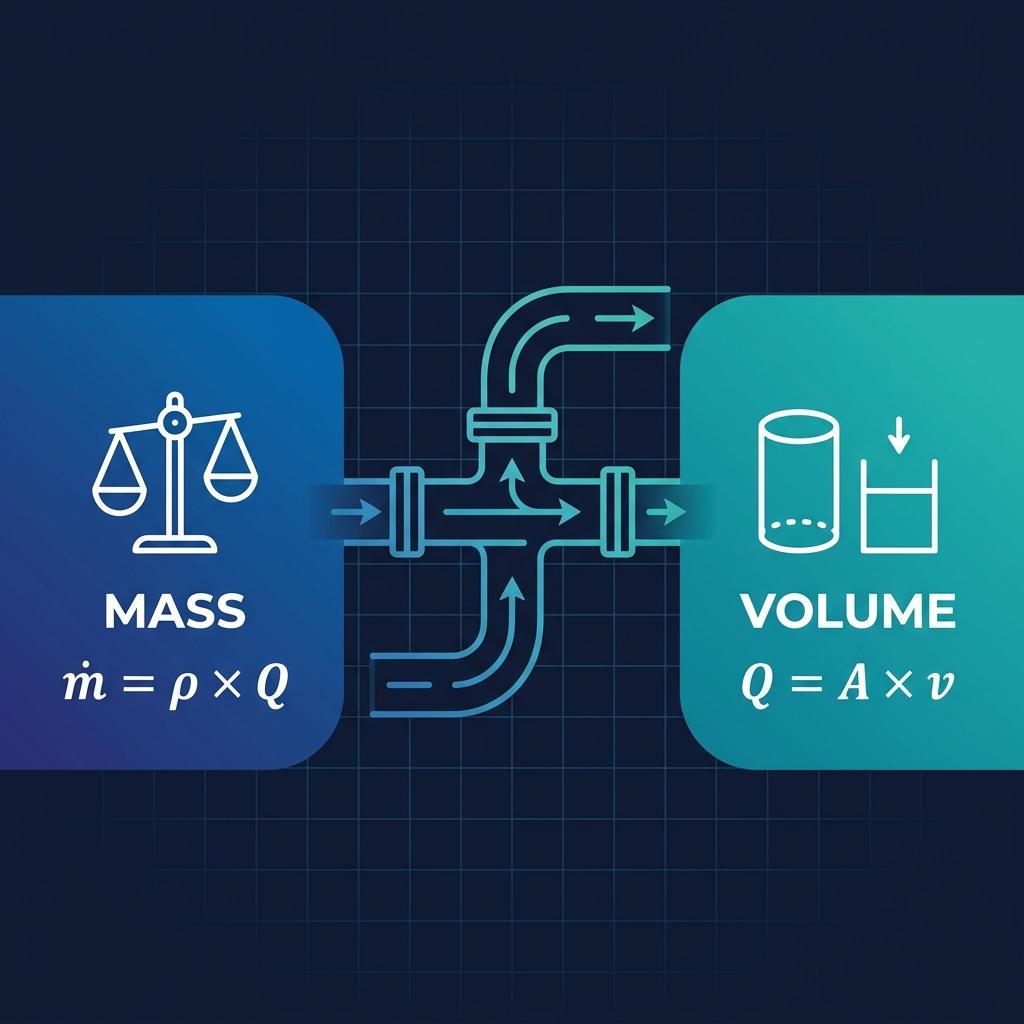
Quick Answer: Mass flow rate measures the mass of fluid passing a point per unit of time (e.g., kg/s). Volumetric flow rate measures the volume of fluid per unit of time (e.g., m³/s). The critical difference: mass flow stays constant regardless of temperature and pressure changes, while volumetric flow varies with these conditions. The conversion formula is: ṁ = ρ × Q, where ρ is fluid density.
What Is Volumetric Flow Rate?
Definition & Formula
Volumetric flow rate — represented by the symbol Q (sometimes written as V̇) — is the volume of fluid that passes through a given cross-sectional area per unit of time. In physics and engineering, it quantifies how much space a gas or liquid occupies as it moves through a system.
The fundamental formula is:
Q = dV/dt
In practical applications, this is often calculated as:
Q = A × v
Where:
- Q = volumetric flow rate (m³/s)
- A = cross-sectional area of the pipe or conduit (m²)
- v = average velocity of the fluid flow (m/s)
For example, if water flows through a pipe with an inner diameter of 0.1 m at a velocity of 2 m/s:
- A = π × (0.05)² = 0.00785 m²
- Q = 0.00785 × 2 = 0.0157 m³/s (or 942 L/min)
Key characteristic: Volumetric flow rate changes with temperature and pressure. When a gas heats up, it expands — the same mass of gas occupies more volume. This is why volumetric flow rate alone can be misleading for gas measurement.
Volumetric Flow Rate Units: Complete Reference Table
| Unit | Symbol | System | Common Applications |
|---|---|---|---|
| Cubic meters per second | m³/s | SI | Large-scale industrial, hydrology |
| Cubic meters per hour | m³/h | SI | HVAC, water treatment |
| Liters per minute | L/min (LPM) | Metric | Laboratory, medical, small process |
| Liters per hour | L/h | Metric | Chemical dosing, precision flow |
| Milliliters per minute | mL/min | Metric | Laboratory, pharmaceutical |
| Gallons per minute | GPM | US Customary | Water systems, firefighting, HVAC (US) |
| Cubic feet per minute | CFM | US Customary | HVAC, compressed air (US) |
| Cubic feet per second | ft³/s (CFS) | US Customary | River discharge, large pipeline |
What Is Mass Flow Rate?
Definition & Formula
Mass flow rate — represented by the symbol ṁ (pronounced “m-dot,” using Newton’s notation for a time derivative) — is the mass of fluid that passes through a given point per unit of time. Instead of measuring how much space a fluid occupies, it measures how much material is actually moving through a system.
The fundamental definition from physics is:
ṁ = dm/dt
And the practical relationship to volumetric flow rate is:
ṁ = ρ × Q = ρ × A × v
Where:
- ṁ = mass flow rate (kg/s)
- ρ = fluid density (kg/m³)
- Q = volumetric flow rate (m³/s)
- A = cross-sectional area (m²)
- v = flow velocity (m/s)
Key characteristic: Mass flow rate remains constant regardless of temperature and pressure changes. This is because mass is conserved — even if a gas expands or compresses, the number of molecules (and therefore the mass) flowing through the system per second stays the same. This principle is rooted in the continuity equation of fluid dynamics.
Note: In technical literature, “mass flow rate” as defined here is sometimes termed “mass flux” or “mass current.” However, mass flux more precisely refers to the rate of mass flow per unit of area (kg/(s·m²)), not the total mass flow rate.
Mass Flow Rate Units: Complete Reference Table
True Mass Units
| Unit | Symbol | System | Common Applications |
|---|---|---|---|
| Kilogram per second | kg/s | SI (base unit) | Engineering calculations, large process |
| Kilogram per hour | kg/h | SI | Industrial process, steam, boiler |
| Gram per second | g/s | Metric | Laboratory, small-scale process |
| Gram per minute | g/min | Metric | Liquid dosing, pharmaceutical |
| Pound per hour | lb/h | US Customary | Steam systems, HVAC (US) |
| Pound per second | lb/s | US Customary | Aerospace, combustion |
| Slug per second | slug/s | US Customary | Aerospace engineering |
Standardized Volumetric Units (Actually Represent Mass Flow)
| Unit | Symbol | Reference Conditions | Common Applications |
|---|---|---|---|
| Standard cubic centimeters per minute | SCCM | 0°C, 1 atm | Semiconductor, lab gas control |
| Standard liters per minute | SLM / SLPM | 0°C, 1 atm | Gas flow control, mass flow controllers |
| Standard cubic feet per minute | SCFM | 60°F (15.6°C), 14.7 psia | Compressed air, natural gas (US) |
| Standard cubic feet per hour | SCFH | 60°F (15.6°C), 14.7 psia | Gas utility metering (US) |
| Normal cubic meters per hour | Nm³/h | 0°C, 1 atm (101.325 kPa) | Industrial gas, Europe |
| Normal liters per minute | NLPM | 20°C, 1 atm | European standard gas flow |
⚠️ The STP Confusion: Why “Standard” Volume Units Are Actually Mass Flow Units
This is one of the most misunderstood concepts in flow measurement, and we’ve seen it cause real problems in the field.
Units like SCCM, SLM, SCFM, and Nm³/h look like volumetric units because they contain “cubic centimeters” or “liters.” But they are actually mass flow units in disguise. Here’s why:
These units express “what volume this mass of gas would occupy if it were at a specific set of standard temperature and pressure conditions.” Since those reference conditions are fixed, a given SCCM reading always represents the same number of molecules (same mass) — regardless of the actual temperature and pressure in your pipe.
The problem? Different organizations use different “standard” conditions:
| Standard | Temperature | Pressure | Used By |
|---|---|---|---|
| STP (American) | 0°C (32°F) | 1 atm (101.325 kPa) | SCCM, SLM — Semiconductor, Alicat, Bronkhorst |
| NTP (European “normal”) | 20°C (68°F) | 1 atm (101.325 kPa) | NLPM, Nm³/h (some EU standards) |
| IUPAC Standard | 0°C (273.15 K) | 100 kPa | IUPAC chemistry references |
| US Natural Gas Industry | 60°F (15.56°C) | 14.696 psia | SCFM, SCFH — US gas utilities |
| ISO 13443 | 15°C (59°F) | 101.325 kPa | International natural gas trade |
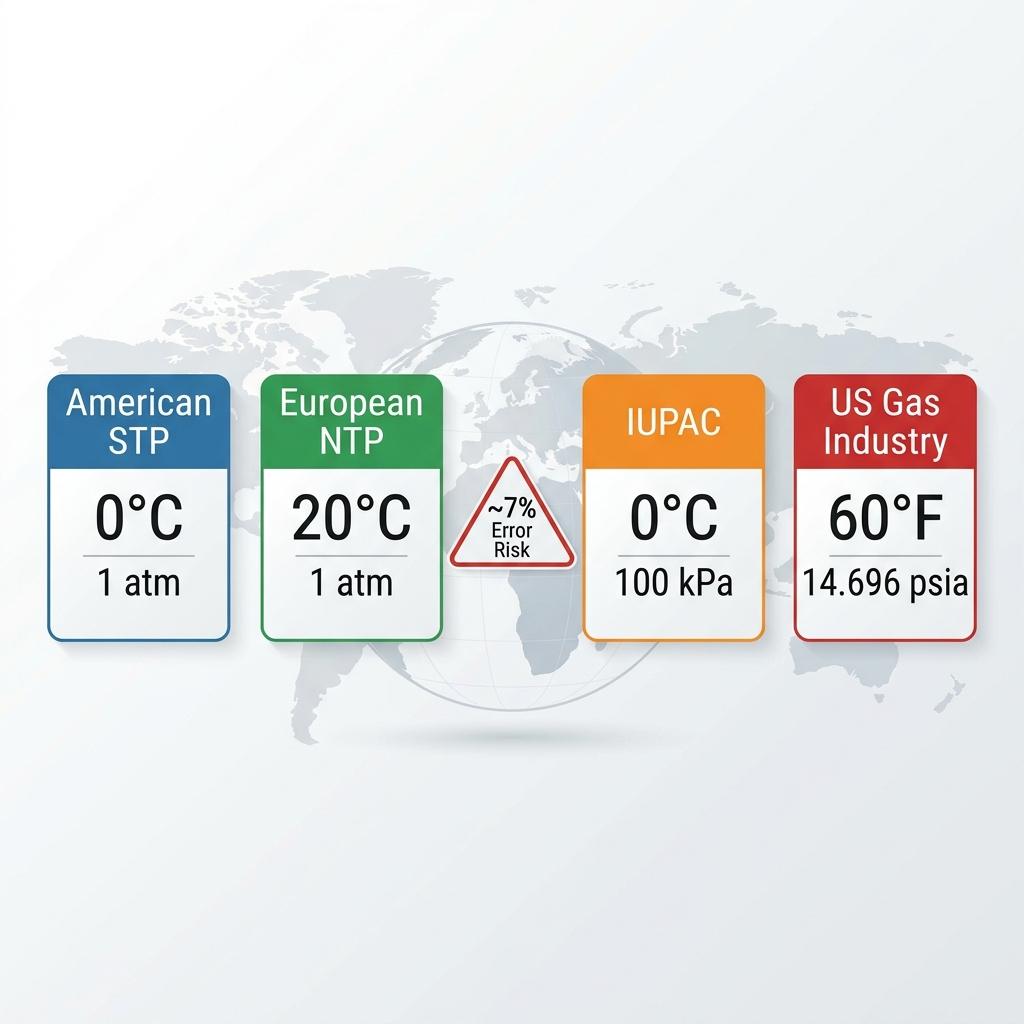
⚠️ Lessons from the Field: We once assisted a chemical plant that was receiving gas flow readings from two different instruments — one calibrated to 0°C STP and another to 20°C NTP. The readings differed by approximately 7.3%, which went undetected for weeks. This mismatch caused a systematic error in their chemical dosing ratio, leading to off-spec product batches. The fix was simple — standardize both instruments to the same reference conditions — but the lesson was costly. Always verify which STP/NTP your instruments use before comparing readings.
Mass Flow Rate vs Volumetric Flow Rate: Key Differences
Side-by-Side Comparison Table
| Feature | Volumetric Flow Rate (Q) | Mass Flow Rate (ṁ) |
|---|---|---|
| What it measures | Volume of fluid per unit of time | Mass of fluid per unit of time |
| Symbol | Q (or V̇) | ṁ (m-dot) |
| SI Unit | m³/s | kg/s (kilogram per second) |
| Affected by temperature? | ✅ Yes — gases expand when heated | ❌ No — mass is conserved |
| Affected by pressure? | ✅ Yes — gases compress under pressure | ❌ No — mass is conserved |
| Best for liquids? | ✅ Yes — liquid density is nearly constant | ✅ Yes — but often unnecessary |
| Best for gases? | ⚠️ Only with T&P compensation | ✅ Yes — preferred for accuracy |
| Relationship | ṁ = ρ × Q | Q = ṁ / ρ | |
When Does It Actually Matter? Real-World Impact
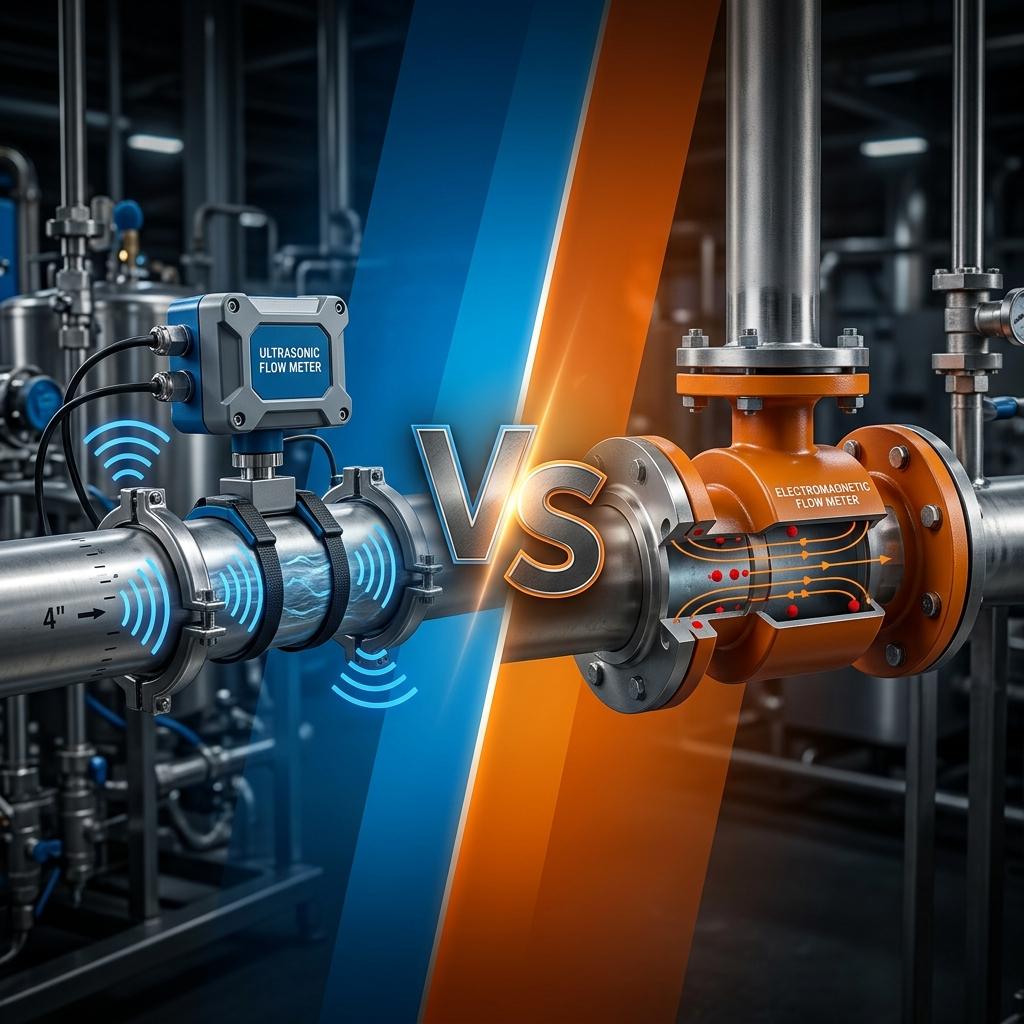
For liquids: In most cases, the difference is negligible. Water density at 20°C is 998.2 kg/m³; at 50°C it’s 988.0 kg/m³ — only a 1% change. For water treatment and HVAC applications, volumetric flow rate is perfectly adequate. That’s why electromagnetic flow meters — which measure volumetric flow — dominate these industries.
For gases: The difference is critical. Consider air at atmospheric pressure: at 0°C its density is 1.293 kg/m³, but at 100°C it drops to 0.946 kg/m³ — a 27% change. If you’re measuring compressed air at 7 bar gauge versus atmospheric pressure, the density differs by a factor of 8. Using the Ideal Gas Law (PV = nRT), the volume of a gas changes directly with temperature and inversely with pressure. This means the same mass flow of gas will show wildly different volumetric flow readings at different conditions.
How to Convert Between Mass and Volumetric Flow Rate
The Core Formula
The relationship between mass flow rate and volumetric flow rate is straightforward:
ṁ = ρ × Q
Or rearranged:
Q = ṁ / ρ
Where ρ (rho) is the fluid density at the actual operating conditions (not standard conditions, unless you want to calculate standard volumetric flow).
Worked Example 1: Water at Different Temperatures
Scenario: A pipe delivers water at a volumetric flow rate of 10 m³/h. What is the mass flow rate at 20°C vs. 80°C?
| Condition | Water Density (ρ) | Q | ṁ = ρ × Q | Difference |
|---|---|---|---|---|
| 20°C | 998.2 kg/m³ | 10 m³/h | 9,982 kg/h | Baseline |
| 80°C | 971.8 kg/m³ | 10 m³/h | 9,718 kg/h | −2.6% |
Takeaway: For water, the volumetric-to-mass difference is small (2-3%). In most water applications, an electromagnetic or ultrasonic flow meter measuring volume flow is sufficient.
Worked Example 2: Compressed Air with Pressure Compensation
Scenario: A compressed air line reads 100 CFM (actual) at 7 bar gauge (8 bar absolute) and 35°C. What is the equivalent flow at standard conditions (SCFM at 1 atm, 15.6°C)?
Using the Ideal Gas Law correction:
Q_standard = Q_actual × (P_actual / P_standard) × (T_standard / T_actual)
- Q_actual = 100 CFM
- P_actual = 8 bar abs = 800 kPa
- P_standard = 1.01325 bar = 101.325 kPa
- T_actual = 35°C = 308.15 K
- T_standard = 15.6°C = 288.75 K
Q_standard = 100 × (800 / 101.325) × (288.75 / 308.15) = 100 × 7.895 × 0.937 ≈ 740 SCFM
Takeaway: The same physical flow shows as 100 CFM (actual) but 740 SCFM (standard). That’s a 7.4× difference — and exactly why mass flow measurement (or standardized volumetric flow) is essential for gas applications. A thermal mass flow meter would read the correct mass flow directly, without requiring this manual compensation.
Common Flow Rate Unit Conversion Quick Reference
| From | To | Multiply By |
|---|---|---|
| m³/s | L/min | 60,000 |
| m³/h | GPM | 4.403 |
| L/min | GPM | 0.2642 |
| CFM | m³/h | 1.699 |
| GPM | m³/h | 0.2271 |
| kg/s | lb/h | 7,937 |
| kg/h | lb/h | 2.205 |
| SCFM (air) | Nm³/h | 1.607 |
| SLPM | SCCM | 1,000 |
Note: Gas conversions assume the same reference conditions. For cross-standard conversions (e.g., SCFM at 60°F to Nm³/h at 0°C), additional temperature correction is required. Refer to Engineering ToolBox flow unit converter for precise values.
Which Flow Meters Measure Mass Flow vs Volume Flow?
Not all flow meters measure the same thing. Understanding which meter delivers mass flow and which delivers volumetric flow is critical for accurate flow rate measurements. Based on our experience installing and commissioning hundreds of meters, here’s the definitive mapping:
Flow Meter Type → Measurement Type
| Flow Meter Type | Measures | Notes | Soaring Product? |
|---|---|---|---|
| Electromagnetic Flow Meter | Volumetric | Measures velocity of conductive liquid; calculates volume flow. Accuracy ±0.5% (±0.2% customized). DN3–DN3000. | ✅ Yes |
| Thermal Gas Mass Flow Meter | Mass (Direct) | Measures heat transfer proportional to mass flow. No T/P compensation needed. Turndown ratio 100:1. Accuracy ±1.0% / ±1.5%. Min velocity 0.1 Nm/s. | ✅ Yes |
| Coriolis Mass Flow Meter | True Mass | Measures tube vibration caused by fluid inertia. Highest accuracy for both gas and liquid mass flow. | ❌ (Industry reference) |
| Vortex Flow Meter | Volumetric (with T/P compensation → mass) | Measures vortex shedding frequency proportional to velocity. LUGB-Z model includes built-in T/P compensation. | ✅ Yes |
| Turbine Flow Meter | Volumetric | Rotor speed proportional to flow velocity. High precision ±0.2%R for liquid. Ideal for custody transfer. | ✅ Yes |
| Ultrasonic Flow Meter (Clamp-On) | Volumetric | Transit-time method measures velocity non-invasively. Accuracy ±1%. No pipe cutting required. | ✅ Yes |
| Differential Pressure (Orifice/Venturi) | Volumetric (inferred) | Measures ΔP to calculate velocity; requires density input for mass flow calculation. | ✅ DP Transmitter |
How to Choose: Decision Flowchart
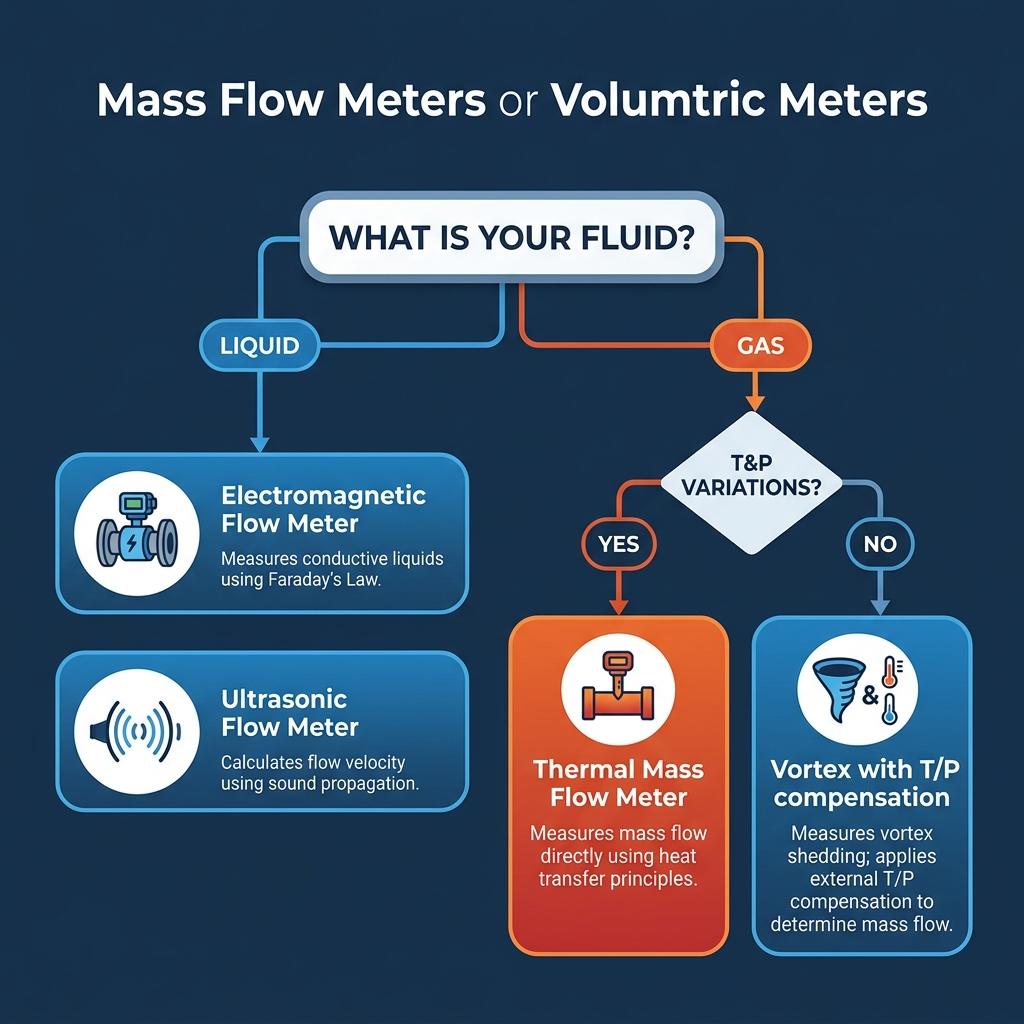
Use this quick decision process to determine which flow measurement type — and which meter — fits your application:
- Is your fluid a gas or liquid?
- Liquid → Volumetric flow is usually sufficient (density is stable). Consider an electromagnetic flow meter for conductive liquids or a clamp-on ultrasonic flow meter for non-invasive measurement.
- Gas → Go to step 2.
- Does your gas experience significant temperature and pressure variations?
- Yes → Mass flow measurement is essential. Use a thermal gas mass flow meter (direct mass) or a vortex meter with T/P compensation.
- No (stable conditions) → Volumetric with known density correction may suffice.
- Is this for custody transfer or chemical dosing?
- Yes → Mass flow is always preferred for billing accuracy and reaction stoichiometry.
- No → Volumetric is often adequate and more cost-effective.
Our thermal gas mass flow meters are particularly well-suited for compressed air monitoring, flare gas measurement, and industrial gas flow applications. With a velocity range of 0.1–120 Nm/s and a 100:1 turndown ratio (accuracy ±1.0% / ±1.5%), they handle both high-velocity process lines and low-flow leak detection scenarios — a versatility that volumetric meters simply cannot match.
Application Guide: When to Use Each Type
Best Applications for Volumetric Flow Rate
- Water & wastewater treatment — monitoring pump output, distribution flow, and wastewater flow rates
- HVAC systems — measuring chilled water and heating water circulation
- Irrigation systems — tracking water delivery volumes
- Tank filling operations — where volume is the primary concern
- Clean liquid processes — food & beverage, pharmaceutical water systems
Best Applications for Mass Flow Rate
- Chemical dosing & reaction control — stoichiometric ratios require mass, not volume
- Gas flow measurement — compressed air audits, nitrogen blanketing, natural gas metering
- Steam measurement — steam flow metering requires mass flow for energy calculations
- Custody transfer & billing — trade settlement for natural gas and industrial gases
- Combustion control — air-fuel ratio optimization in boilers and furnaces
- Emissions monitoring — environmental reporting requires mass-based data (kg/h of pollutant)
Lessons from the Field: Chemical Plant Gas Mixing
📋 Case Study — Petrochemical Gas Blending Facility
A petrochemical facility was blending two process gases at a specified volumetric ratio using rotameter-style flowmeters. However, the upstream gas pressure varied between 2–5 bar depending on the supply tank level. Because volumetric flow rate changes with pressure, the actual mass ratio of the two gases drifted significantly from the target — resulting in an off-spec product that required reprocessing.
Solution: We replaced the volumetric rotameters with Soaring thermal gas mass flow meters (accuracy ±1.0%, turndown 1:1000). Since thermal mass flow meters directly measure mass flow regardless of pressure and temperature changes, the blending ratio remained consistent even as supply pressure fluctuated.
Result: Product reject rate dropped by 35%, and the facility eliminated the need for a dedicated pressure regulation system on the supply line — saving approximately $12,000 in annual maintenance costs.
Common Mistakes & Misconceptions
| ❌ Misconception | ✅ Reality |
|---|---|
| “SCCM and SLM are volumetric flow units” | They look volumetric but actually represent mass flow — the volume a gas would occupy at fixed reference conditions. The number of molecules (mass) is what stays constant. |
| “For liquids, it doesn’t matter which you measure” | Mostly true for water at ambient temperatures. But for hot fluids (steam condensate, thermal oil) or precise dosing (pharmaceutical), the density change can matter. |
| “Any flow meter can measure mass flow directly” | Only thermal mass flow meters and Coriolis meters measure mass directly. All other types measure velocity or volume and require density input to calculate mass. |
| “Standard conditions are universal” | STP means different things in different countries and industries. Mixing up 0°C vs 20°C reference temperature causes a ~7% error in gas measurements. |
| “Higher flow rate = higher mass flow rate” | Not necessarily. A hot gas has higher volumetric flow (expanded volume) but the same mass flow rate. Volume flow rate and mass flow rate can move in opposite directions if conditions change. |
Frequently Asked Questions (FAQ)
What is the formula for mass flow rate?
The mass flow rate formula is ṁ = ρ × Q, where ṁ is mass flow rate (kg/s), ρ is the fluid density (kg/m³), and Q is the volumetric flow rate (m³/s). It can also be expressed as ṁ = ρ × A × v, where A is the cross-sectional area and v is the flow velocity. The fundamental physics definition is ṁ = dm/dt (mass change per unit of time).
What are the SI units for volumetric flow rate?
The SI unit for volumetric flow rate is cubic meters per second (m³/s). In practice, common units include cubic meters per hour (m³/h), liters per minute (L/min), and in the US customary system, gallons per minute (GPM) and cubic feet per minute (CFM).
Can you convert volumetric flow rate to mass flow rate?
Yes. Multiply the volumetric flow rate by the fluid’s density: ṁ = ρ × Q. For liquids, density is relatively constant. For gases, you must know the density at the actual operating temperature and pressure, or use the Ideal Gas Law (PV = nRT) to calculate it. Always verify which reference conditions (STP/NTP) apply when working with standardized units like SCCM or Nm³/h.
Why is mass flow rate preferred for gas measurement?
Because gas volume changes significantly with temperature and pressure (per the Ideal Gas Law PV=nRT), while mass remains constant. A gas at 7 bar occupies roughly 1/7th the volume it would at atmospheric pressure, but its mass flow rate stays the same. Mass flow measurement eliminates the need for separate pressure and temperature compensation, providing more accurate flow rate measurements for billing, process control, and environmental compliance.
What is STP in flow measurement?
STP stands for Standard Temperature and Pressure — a set of reference conditions used to normalize gas flow readings. However, “standard” varies by region: American STP is typically 0°C and 1 atm; European NTP uses 20°C and 1 atm; and the US natural gas industry uses 60°F (15.56°C) and 14.696 psia. Mixing up these standards can cause measurement errors of approximately 7%.
Which flow meter measures mass flow directly?
Two main types: (1) Thermal gas mass flow meters measure heat transfer proportional to gas mass flow — ideal for industrial gas applications with turndown ratios up to 1:1000. (2) Coriolis mass flow meters measure tube vibration caused by fluid inertia — the most accurate for both gas and liquid mass flow. All other flow meter types (electromagnetic, ultrasonic, vortex, turbine) measure volumetric flow and require density input to calculate mass flow.
Does temperature affect volumetric flow rate?
Yes, significantly for gases and slightly for liquids. When gas temperature increases, its volume expands (per Charles’s Law), so the volumetric flow rate increases even though the same mass of gas is flowing. For example, air at 100°C occupies about 37% more volume than at 0°C. For liquids, the effect is much smaller — water density changes only about 4% between 0°C and 100°C.
Conclusion: 5 Key Takeaways
- Mass flow rate (ṁ) measures mass per time; volumetric flow rate (Q) measures volume per time. They are related by the formula ṁ = ρ × Q.
- Mass flow is independent of temperature and pressure; volumetric flow is not. This makes mass flow essential for gas measurement and any application where conditions vary.
- “Standard” volumetric units (SCCM, SLM, SCFM, Nm³/h) are actually mass flow units. Always verify which reference conditions (STP/NTP) your instruments use.
- For liquid applications, volumetric flow meters (electromagnetic, ultrasonic, turbine) are typically sufficient and cost-effective.
- For gas applications, thermal mass flow meters provide direct mass flow measurement without T/P compensation — the simplest and most accurate flow measurement approach.
Need Help Choosing the Right Flow Meter?
At Soaring Instrument, we manufacture both volumetric flow meters (electromagnetic, vortex, turbine, ultrasonic) and thermal gas mass flow meters — giving us a unique perspective to recommend the right technology for your specific application.
Whether you need to measure and control the mass flow of compressed air in a pneumatic system, monitor the volume flow of cooling water in an HVAC loop, or measure accurate flow in a chemical process, our engineering team can help you select the optimal solution.
- 📧 [email protected]
- 📞 0086-13585991410
- 🌐 Contact Us Online
Related Articles
- How Do Different Types of Flow Meters Work?
- How Does Differential Pressure Relate To Flow Rate?
- Magnetic Flow Meter: How It Works & Selection Guide
- What Is the Effect of Temperature on Flow Measurement?
- Steam Flow Meter: Types, Selection & Best Practices
- EMF vs. Ultrasonic vs. Coriolis Flowmeters: Which Wins?
- How To Calculate Wastewater Flow Rate?
- What Is the Most Commonly Used Flow Meter?