A slurry magnetic flow meter is the industry standard for measuring abrasive, high-solids fluids like manure — but choosing the wrong configuration can cost you thousands in premature failures. This case study walks through a real project where we helped a 2,000-head dairy farm solve their manure flow measurement problem, from initial assessment to 18 months of trouble-free operation.
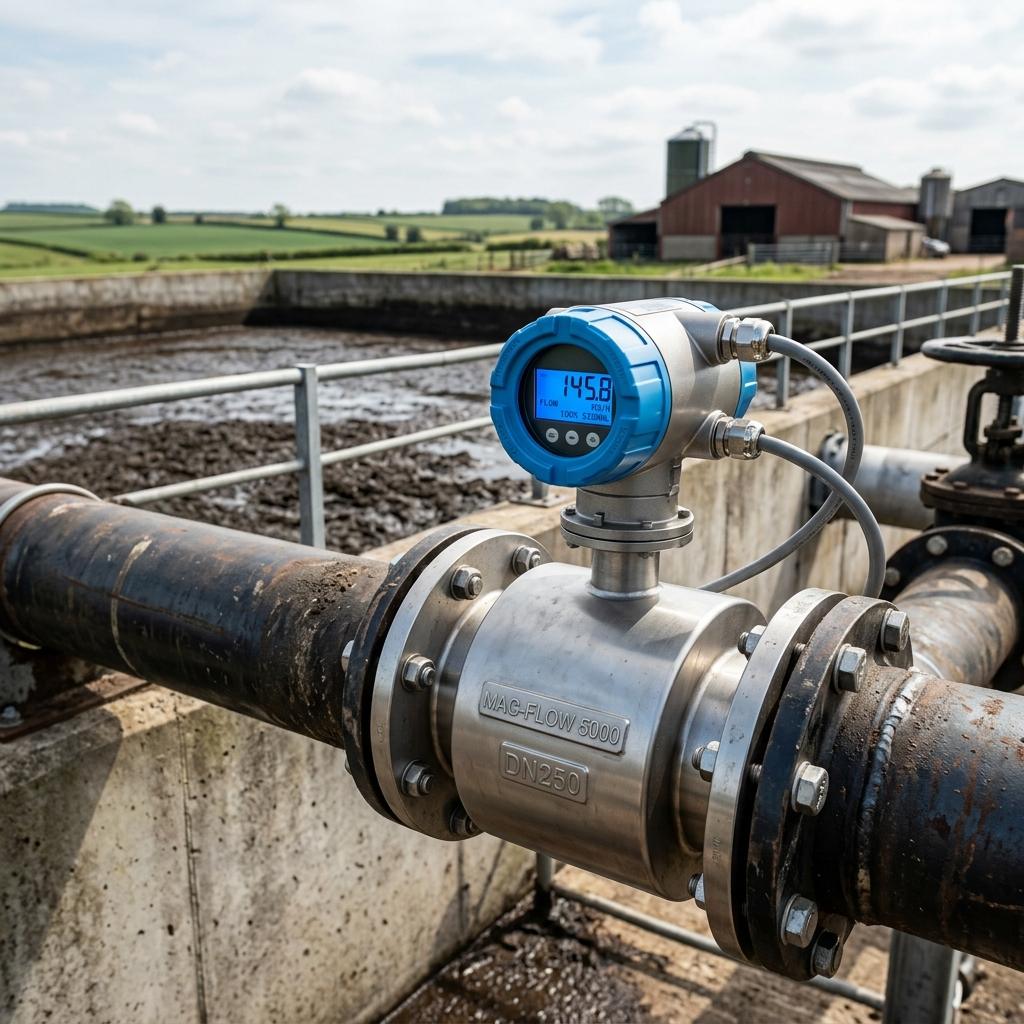
Quick Answer: For manure slurry measurement, a magnetic flow meter with rubber liner, Hastelloy C electrodes, and proper velocity control (1.5–3 m/s) delivers ±0.5% accuracy with virtually zero maintenance — even in fluids with up to 12% solids content.
Related Guide: Magnetic Flow Meter: How It Works & Selection Guide
The Challenge: Why Measuring Manure Slurry Flow Is So Difficult
A 2,000-head dairy operation in the U.S. Midwest contacted us with a familiar problem. Their farm produces approximately 60 m³ of manure slurry per day, and they needed accurate flow data for two reasons:
- Nutrient Management Plan (NMP) compliance — EPA regulations require precise records of how much manure is land-applied per acre to prevent nitrogen and phosphorus runoff.
- Cost control — without accurate measurement, they were over-applying by an estimated 20–30%, wasting money and risking environmental violations.
Their previous setup used a mechanical propeller-type flow meter on the transfer line from the lagoon to the tanker truck loading station. It lasted roughly 3 months before the impeller seized from fiber entanglement and grit accumulation.
What Makes Manure Slurry So Challenging?
Manure slurry is not water. It’s a complex, variable mixture that defeats most conventional flow meters:
| Property | Clean Water | Manure Slurry (Typical) | Impact on Flow Measurement |
|---|---|---|---|
| Solids Content | 0% | 5–12% (up to 15%) | Clogs mechanical meters; causes abrasion |
| Fiber / Debris | None | Straw, hair, feed residue | Wraps around impellers and turbine blades |
| Viscosity | 1 cP | 10–100 cP (varies with solids) | Reduces accuracy of differential pressure meters |
| Abrasiveness | Non-abrasive | Sand, grit, mineral particles | Erodes liners, damages electrodes |
| Corrosivity | Neutral | pH 6.5–8.5, ammonia, H₂S | Attacks wetted metal parts over time |
| Conductivity | ~500 µS/cm | 5,000–20,000 µS/cm | High conductivity — ideal for electromagnetic measurement |
| Entrained Air | Minimal | Often 2–5% gas | Creates signal noise and reading instability |
The previous propeller meter failed because it simply wasn’t designed for this environment. Moving parts + abrasive slurry = guaranteed failure.
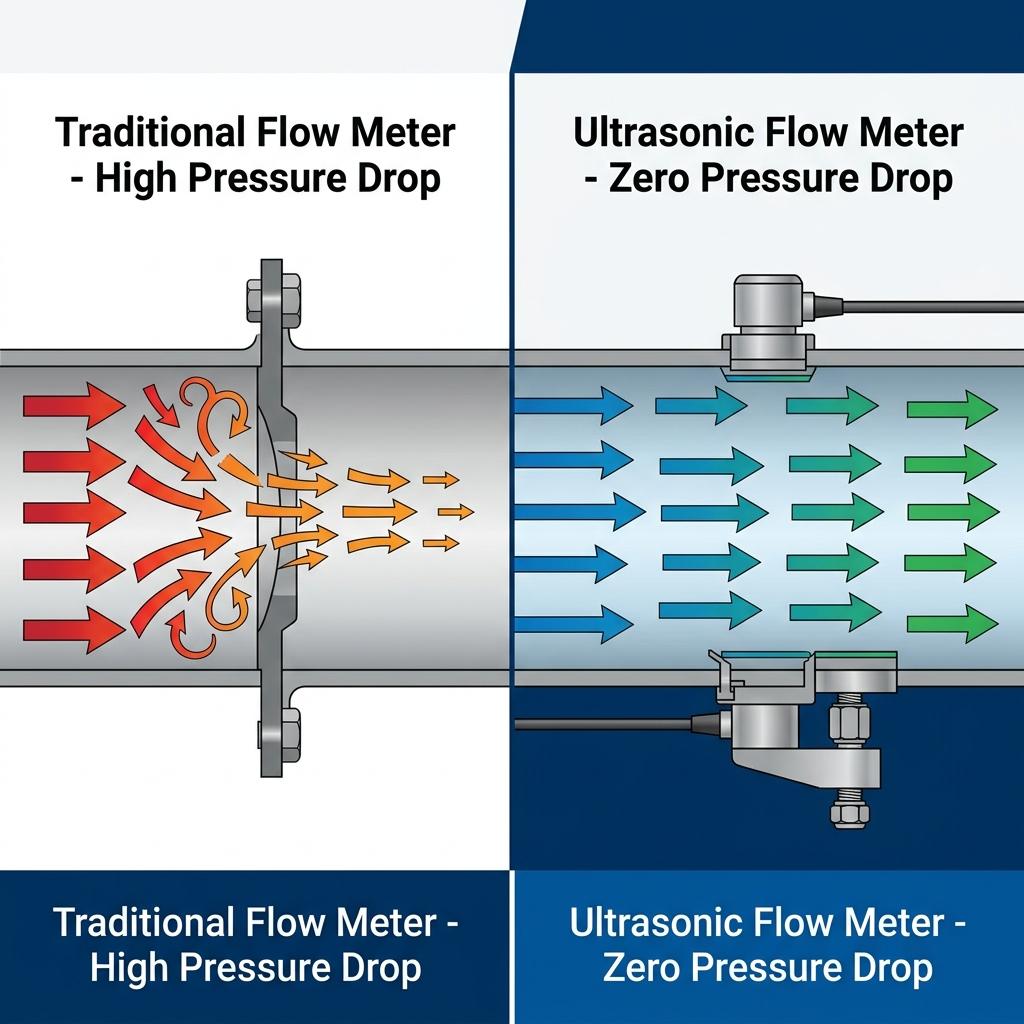
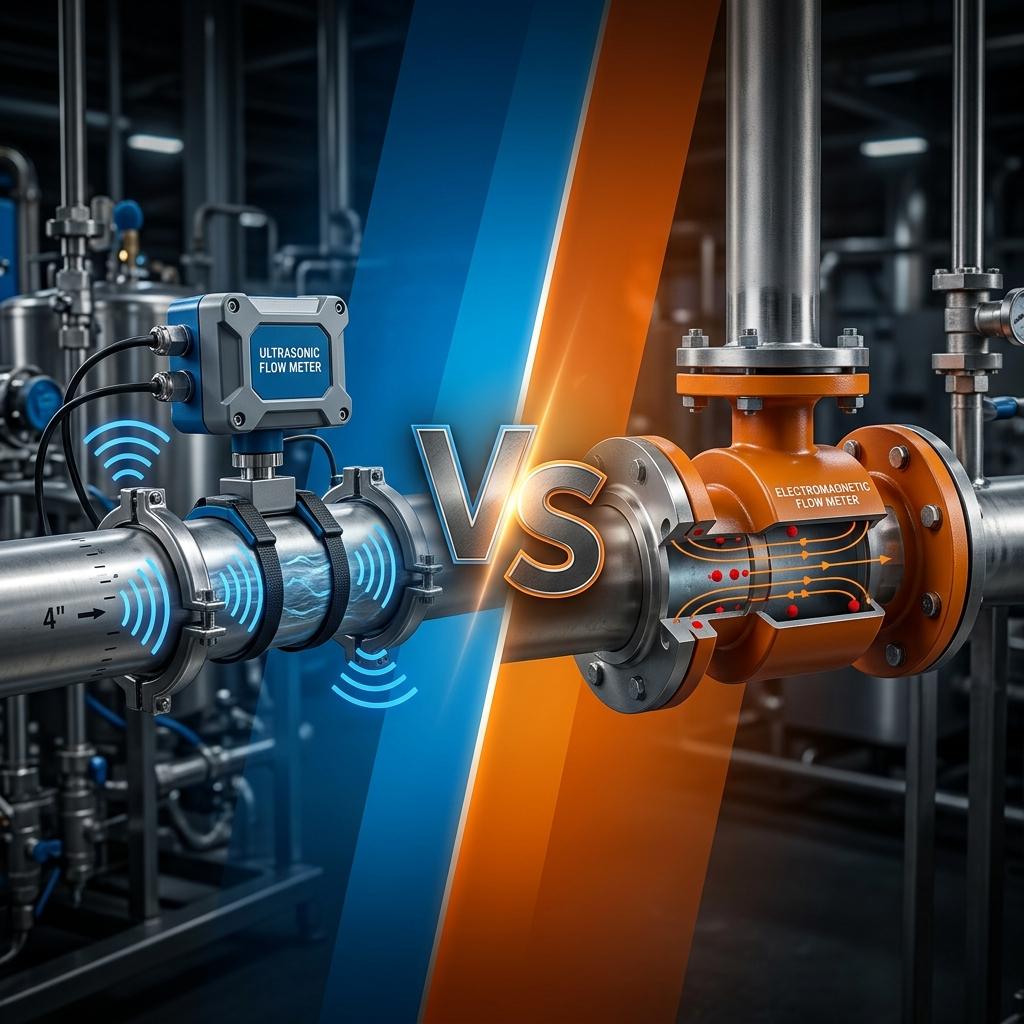
Lesson from the field: We’ve seen farms try ultrasonic flow meters for manure lines. The problem? Suspended solids scatter the acoustic signal, making transit-time ultrasonic meters unreliable. Doppler ultrasonic meters work slightly better, but they measure velocity at a single point rather than across the full pipe profile, which introduces significant error in non-homogeneous slurries. Read more: What Is the Difference Between Electromagnetic and Ultrasonic Flow Meters
Why We Recommended a Magnetic Flow Meter for This Application
After reviewing the farm’s operating conditions, we recommended a slurry-grade electromagnetic flow meter. Here’s why.
The Principle: Faraday’s Law Works in Your Favor
A magnetic flow meter operates on Faraday’s Law of Electromagnetic Induction: when a conductive fluid moves through a magnetic field, it generates a voltage proportional to its velocity.
E = B × D × V
Where:
- E = induced voltage (V)
- B = magnetic field strength (T)
- D = pipe inner diameter (m)
- V = average fluid velocity (m/s)
Manure slurry is highly conductive (5,000–20,000 µS/cm) — far above the minimum 20 µS/cm threshold required for electromagnetic measurement. This makes it an ideal candidate for mag meter technology. Learn more: How Electromagnetic Flowmeters Work: Faraday’s Law in Action
Why Other Flow Meter Types Don’t Work Here
| Flow Meter Type | Works for Manure Slurry? | Why / Why Not |
|---|---|---|
| Electromagnetic (Mag Meter) | ✅ Yes — Best Choice | No moving parts, full-bore design, handles high solids, highly accurate |
| Turbine / Propeller | ❌ No | Impeller clogs with fibers; grit destroys bearings within weeks |
| Ultrasonic (Transit-Time) | ❌ No | Suspended solids scatter acoustic signal; unreliable readings |
| Ultrasonic (Doppler) | ⚠️ Limited | Measures only one point; accuracy degrades with non-uniform particle distribution |
| Coriolis Mass Flow | ⚠️ Possible but Expensive | Accurate for slurry, but 5–10× the cost; pressure drop concerns with large pipes |
| Vortex | ❌ No | Shedder bar obstructs flow; fibers accumulate; not designed for slurry |
| Differential Pressure (Orifice) | ❌ No | Orifice plate erodes rapidly; pressure taps clog with solids |
The bottom line: for conductive slurries with high solids content, a magnetic flow meter is the only technology that combines accuracy, reliability, and reasonable cost.
For a detailed comparison, see: Electromagnetic Flow Meters vs. Other Flow Meters: Which One Is Right for Your Industry
Project Configuration: How We Specified the Right Meter
Selecting a magnetic flow meter for slurry isn’t just about choosing a “slurry model.” Every component — from the liner to the electrode to the pipe diameter — must be matched to the specific application. Here’s exactly how we configured this project.
Step 1: Define the Working Conditions
The farm provided the following operating parameters:
| Parameter | Value | Notes |
|---|---|---|
| Medium | Dairy manure slurry | Mixed with bedding material and wash water |
| Solids Content | 6–10% | Varies seasonally; screened before pumping |
| Pipe Size | 8 inches (DN200) | Existing pipeline from lagoon |
| Flow Rate | 80–200 m³/h | Pump-driven, variable speed |
| Temperature | 5–35°C | Seasonal variation |
| Pressure | ≤1.6 MPa | Pump discharge pressure |
| Conductivity | ~10,000 µS/cm | Well above ≥20 µS/cm minimum |
| Installation | Horizontal, pump station | Lagoon-to-tanker transfer line |
Step 2: Liner Selection — The First Line of Defense
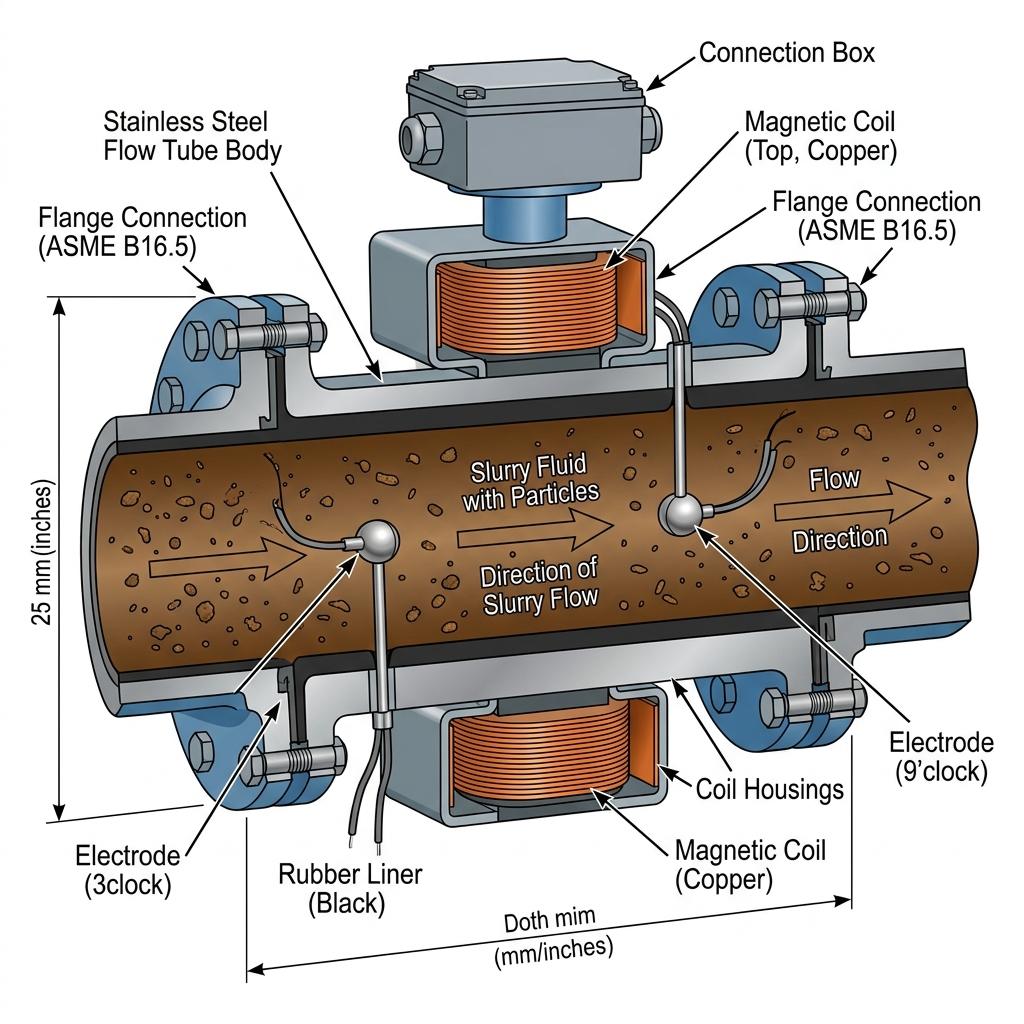
The liner is the most critical component in a slurry application. It protects the flow tube from erosion and corrosion while providing electrical insulation.
| Liner Material | Best For | Abrasion Resistance | Max Temp | Our Verdict for This Project |
|---|---|---|---|---|
| Rubber (Hard Rubber) | Slurries, wastewater, manure | ⭐⭐⭐⭐ Good — handles moderate abrasion well | 80°C | ✅ Selected — best all-around choice for manure slurry with moderate abrasion and corrosion |
| PTFE | Corrosive chemicals, acids, high-temp | ⭐⭐ Fair | 180°C | ❌ Not recommended — excellent chemical resistance but poor abrasion resistance for manure grit |
| Polyurethane (PU) | Heavy abrasive slurries, mining | ⭐⭐⭐⭐⭐ Excellent | 60°C | Consider for extremely abrasive slurries (mining ore, dredging sand) — available on request |
| Ceramic (Al₂O₃) | Extreme abrasion (mining ore) | ⭐⭐⭐⭐⭐ Superior | 180°C | Overkill for this application; significantly higher cost |
| Neoprene | Low-abrasion wastewater | ⭐⭐⭐ Moderate | 70°C | ❌ Insufficient for 6–10% solids content |
We selected rubber (hard rubber) because it delivers a strong balance of abrasion resistance, chemical compatibility, and cost-effectiveness for dairy manure slurry at temperatures below 80°C. It’s our standard liner option for slurry-grade electromagnetic flow meters. For more on liner material selection: How Does Liner Material Impact Flow Meter Performance?
Step 3: Electrode Selection — Handling Corrosion + Abrasion
The electrodes are in direct contact with the slurry. They must resist both chemical corrosion (ammonia, H₂S) and physical abrasion (sand/grit impact).
We selected Hastelloy C-276 for this project. While tungsten carbide offers slightly higher hardness, Hastelloy C provides a better all-around balance of corrosion and abrasion resistance for manure — which has a more corrosive chemistry than typical mining slurry.
For applications with heavier grit (e.g., sand dredging, mineral processing), tungsten carbide would be the better choice.
Detailed comparison: Electrode Materials Face-Off: Titanium vs. Hastelloy vs. Platinum
Step 4: Sizing — Why We Didn’t Match the Pipe Size
A common mistake: installing a flow meter with the same diameter as the pipeline. For slurry applications, flow velocity matters more than pipe matching.
The ideal velocity range for slurry measurement is 1.5–3.0 m/s:
- Below 1.5 m/s → solids settle on the pipe bottom, creating measurement errors
- Above 3.0 m/s → accelerated liner erosion, shortened service life
At the farm’s maximum flow rate (200 m³/h) through a DN200 pipe:
- Velocity = Q / A = 200 / (3600 × π × 0.1²) ≈ 1.77 m/s ✅
DN200 was appropriate for this application — the velocity stays within the optimal range (1.5–3.0 m/s) across the full operating range. At minimum flow (80 m³/h), velocity is ~0.71 m/s, which is below the 1.5 m/s threshold. We recommended the farm operate the variable-speed pump above 110 m³/h during normal transfer to keep solids in suspension. If the pipeline had been smaller (DN150), the velocity would have been higher (~2.83 m/s at max flow) — also acceptable.
Installation Best Practices: Lessons from the Field
Getting the meter selection right is only half the battle. Improper installation is the #1 cause of “meter failures” that are actually installation failures.
Installation Layout
For this project, the flow meter was installed on the pump station discharge line that transfers manure from the lagoon to tanker trucks for field application. Key installation decisions:
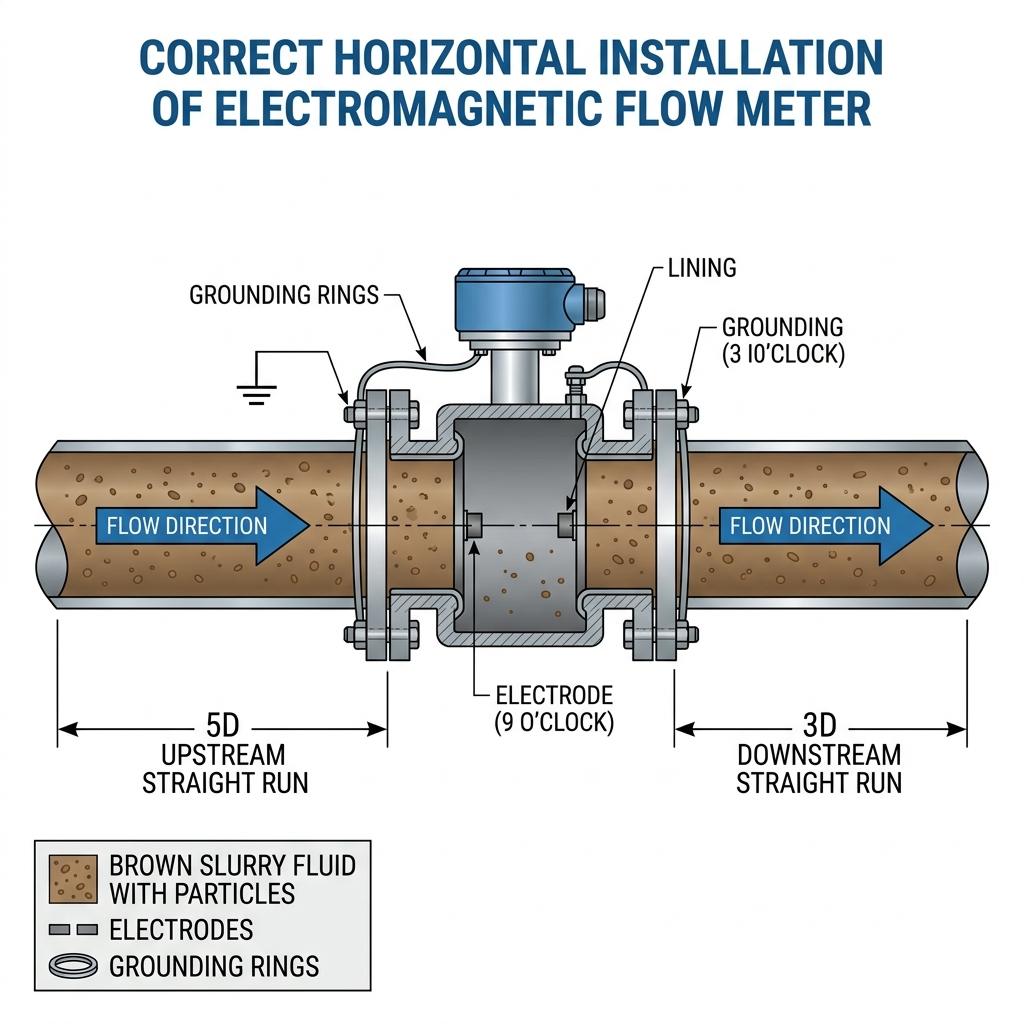
1. Orientation: Horizontal with Electrodes at 3 and 9 O’Clock
We mounted the meter horizontally (matching the existing pipeline) with the electrodes positioned at the horizontal centerline (3 o’clock and 9 o’clock positions). This prevents air bubbles from collecting at the top electrode or solids from settling on the bottom electrode.
For vertical installations (flow upward is preferred to keep the pipe full), see: Can Magnetic Flow Meters Be Installed Vertically?
2. Straight Run: 5D Upstream / 3D Downstream
We ensured 5 pipe diameters of straight pipe upstream and 3 pipe diameters downstream. While modern mag meters are less sensitive to flow disturbances than many other meter types, maintaining adequate straight runs is especially important in slurry applications where turbulence can cause particle impingement on electrodes.
Full piping guide: Magnetic Flow Meter Piping Requirements: Complete Installation Guide
3. Grounding: The Lesson We Learned the Hard Way
During initial commissioning, the flow reading was unstable — fluctuating ±15% despite steady pump operation. The signal trace showed random millivolt spikes — classic “slurry noise.”
The root cause? Missing grounding rings.
Manure slurry generates significant static charge as particles flow through plastic-lined pipes. Without proper grounding, this stray voltage interferes with the small induced signal (typically only a few millivolts).
We installed stainless steel grounding rings on both flanges, and the reading stabilized immediately — fluctuation dropped from ±15% to less than ±1%.
Pro tip: Grounding is non-negotiable for slurry applications. Use grounding rings or grounding electrodes — never rely solely on pipe grounding, especially with plastic or lined piping. Read why: Why Does A Magnetic Flow Meter Need Grounding?
4. Lining Protectors at Inlet/Outlet
We fitted optional metal lining protectors at the meter’s flanged connections. These shields protect the leading edge of the rubber liner from being peeled back or eroded by the high-velocity slurry entering the meter. This small add-on ($50–100) can extend liner life by 2–3× in heavy slurry applications.
Performance Results: Before vs. After
The system has been operating continuously for 18 months since installation. Here are the measured results:
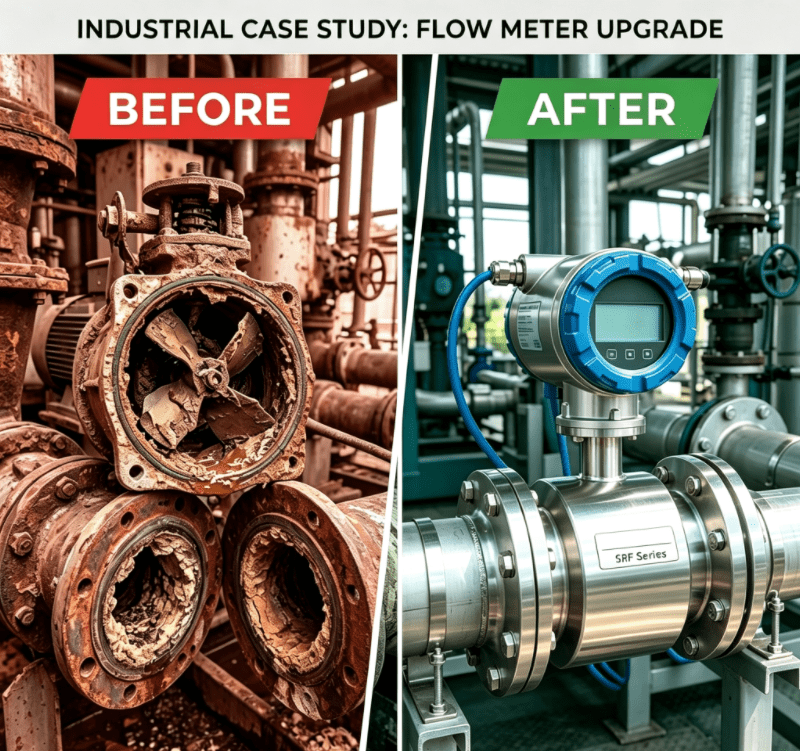
| Metric | Before (Propeller Meter) | After (Slurry Mag Meter) | Improvement |
|---|---|---|---|
| Measurement Accuracy | Unknown (meter often failed) | ±0.5% of reading | From guessing to precision |
| Meter Lifespan | ~3 months before failure | 18+ months, zero issues | 6× longer (and counting) |
| Unplanned Downtime | 3–4 replacements/year | Zero | Eliminated |
| Fertilizer Over-Application | Estimated 20–30% excess | <5% variance from target | ~$8,000–12,000/year savings |
| NMP Compliance Records | Incomplete, manual estimates | Automated, GPS-logged data | Passed audit with zero findings |
| Maintenance Required | Monthly cleaning/replacement | Annual visual inspection only | 95% reduction in maintenance labor |
The farm manager’s comment: “We went from replacing meters every few months to basically forgetting it’s there. The data we get now means we actually know what we’re putting on each field — and that keeps us out of trouble with the state.”
Technical Specifications
Below are the specifications for the electromagnetic flow meter used in this project, based on our standard pipeline electromagnetic flow meter series.
| Parameter | Specification |
|---|---|
| Measurement Principle | Faraday’s Law of Electromagnetic Induction |
| Applicable Media | Conductive liquid, slurry |
| Accuracy | ±0.5% (customized ±0.2%) |
| Velocity Range | 0.1–15 m/s (recommended 1.5–3 m/s for slurry) |
| Turndown Ratio | 150:1 |
| Response Time | ≤ 1 s |
| Pipe Diameter Range | DN3–DN3000 |
| Lining Material | PTFE, Rubber |
| Electrode Material | SUS316, Hastelloy B, Hastelloy C, Titanium, Coated Tungsten Carbide |
| Minimum Conductivity | ≥20 µS/cm |
| Medium Temperature | -40°C to +180°C |
| Working Pressure | Max 42 MPa |
| Protection Rating | IP65, IP68 |
| Output Signal | 4–20 mA, Pulse / Frequency |
| Communication | RS485, HART |
| Power Supply | 220V AC / 24V DC / 3.6V Lithium |
| Explosion Proof | ExdIIa, ExdII CT6 Gb |
| Structure Types | Flange, Thread, Wafer, Tri-clamp, Split (Remote) |
| Pipe / Body Material | Carbon steel / Stainless steel |
Not sure which configuration fits your working condition? Every slurry application is different — solids content, particle size, temperature, chemical composition, and pipe layout all affect the optimal meter configuration. Tell us your working conditions → Our engineers will recommend the right setup
Frequently Asked Questions
What is the best flow meter for manure slurry?
An electromagnetic (magnetic) flow meter is widely considered the gold standard for manure slurry measurement. Its full-bore, obstruction-free design handles high-solids fluids without clogging or mechanical wear. For manure applications specifically, configure the meter with a rubber liner and Hastelloy C or tungsten carbide electrodes for maximum service life.
Can a magnetic flow meter handle high-solids slurry?
Yes. Slurry-grade magnetic flow meters are designed for fluids with solids content up to 50% by volume. For typical manure slurry (5–15% solids), they provide reliable, accurate measurement with minimal signal noise — especially when paired with advanced transmitters that include slurry noise filtering algorithms.
What liner material is best for abrasive manure slurry?
Rubber (hard rubber) is the recommended liner for manure slurry because it provides a strong combination of abrasion resistance and chemical compatibility for fluids containing sand, grit, and fiber at temperatures below 80°C. For highly corrosive chemicals at elevated temperatures, PTFE may be more appropriate — but it offers significantly less wear resistance against abrasive particles. See: How Does Liner Material Impact Flow Meter Performance?
How do you prevent electrode fouling in slurry applications?
Three approaches: (1) Maintain flow velocity above 1.5 m/s to keep solids in suspension and prevent buildup on electrodes. (2) Select flush-mount or pointed electrode designs that resist coating accumulation. (3) Use advanced transmitters with empty pipe detection and electrode coating diagnostics. In severe cases, scraper-type self-cleaning electrodes are available.
What flow velocity is recommended for slurry measurement?
The optimal velocity range for slurry magnetic flow meters is 1.5–3.0 m/s. Below 1.5 m/s, solids may settle and create measurement errors. Above 3.0 m/s (or 5–6 m/s for less abrasive slurries), liner erosion accelerates. If your existing pipe size results in velocities outside this range, use a smaller or larger meter with concentric reducers.
How often does a slurry mag meter need maintenance?
Under proper operating conditions, a slurry magnetic flow meter requires minimal maintenance — typically an annual visual inspection of the liner and electrode condition. There are no wearing parts, no moving components, and no consumables. In our livestock farm project, the meter has operated maintenance-free for 18 months. Expected service life is 10–15+ years with the right liner and electrode configuration.
Can I use a mag meter on a drag-line manure application system?
Yes, and it’s one of the most common configurations. The meter is typically installed at the pump skid discharge (to monitor total volume pumped) and optionally at the tractor-end applicator (to monitor application rate in real time). For drag-line systems, a remote-mount configuration with IP68 sensor protection is recommended to withstand outdoor conditions and potential submersion.
Conclusion: Key Takeaways
- Magnetic flow meters are the gold standard for manure slurry — no moving parts, no clogging, no pressure drop, and high accuracy even in fluids with 6–10% solids content.
- Liner and electrode selection are critical. Rubber + Hastelloy C is the go-to combination for manure. Don’t use PTFE liners in abrasive applications — they’ll fail prematurely.
- Proper installation matters as much as meter selection. Grounding rings, lining protectors, correct electrode orientation, and adequate straight runs can mean the difference between 3 months and 15 years of service life.
- The ROI is measurable. In this project, the farm saved $8,000–12,000/year in reduced over-application alone — paying back the meter investment in the first season.
- Compliance is automatic. With accurate flow data and data logging, Nutrient Management Plan reporting goes from guesswork to push-button.
Ready to Solve Your Slurry Flow Measurement Challenge?
Every slurry application is unique. Pipe size, solids content, particle size, temperature, chemical composition, and flow rate all affect the right meter configuration.
Tell us your working conditions — pipe size, medium, flow rate, temperature — and our engineers will recommend the exact configuration for your application.
Or explore our complete electromagnetic flow meter product line:
- Magnetic Flow Meter: How It Works & Selection Guide
- Can Electromagnetic Flow Meters Handle Corrosive or Abrasive Fluids?
- Say Goodbye to Clogs: How Mag Flow Meters Handle Sludge & Slurries
- What Is the Best Flow Meter for Sludge?
References: Faraday’s Law of Electromagnetic Induction — Wikipedia · EPA Nutrient Management Planning — USDA NRCS · ISO 6817 — Measurement of conductive liquid flow in closed conduits