
Gas Turbine Flow Meter
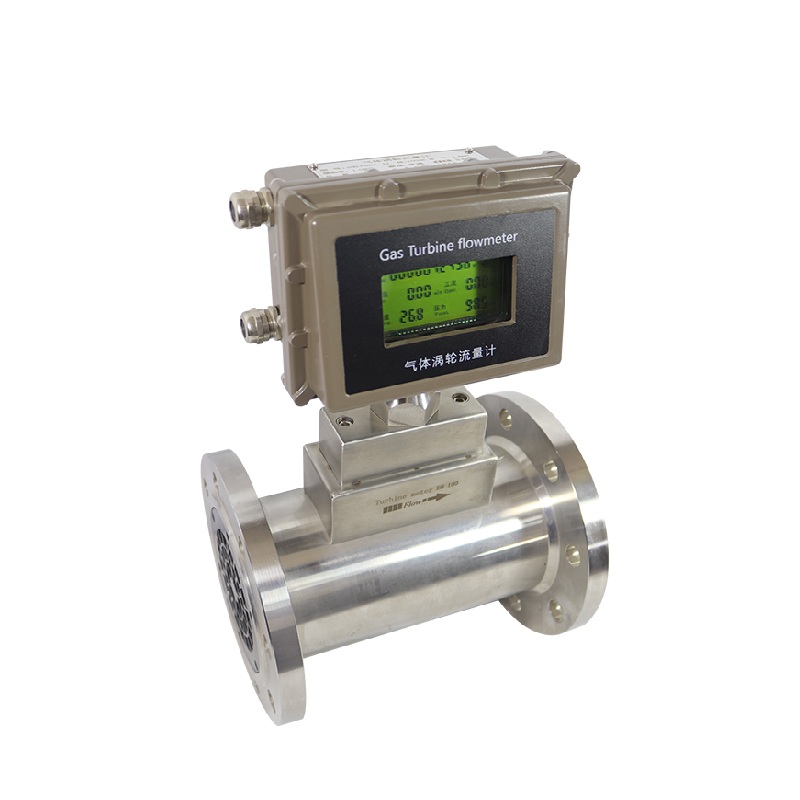
Product Description
✓ IP65 Protection · ✓ CE Compliant · ✓ Ex d IIB T6 Gb Explosion-proof
Pipe Size: DN25 – DN250 (Flange Connection)
Accuracy: ±1.0%R · ±1.5%R
Repeatability: 0.05% – 0.2%
Turndown Ratio: 1:10 · 1:20 · 1:30
Medium Temp: -10°C to +100°C
Pressure Loss: 0.1 – 2.5 kPa (normal pressure)
Body Material: 304 Stainless Steel / Cast Aluminum
Power Supply: Built-in Lithium battery · External 24VDC
Output: 3-wire Pulse | 4–20 mA | RS485 | IC Card
Lead Time: 7–14 working days · MOQ: 1 Unit
Engineer replies within 24 hours · Free technical consultation
Technical Specifications
Performance & Conditions of Use
| Parameter | Specification |
|---|---|
| Measurement Principle | Turbine — impeller rotation frequency proportional to gas flow velocity |
| Measuring Medium | Natural gas, air, nitrogen, and industrial gases — clean, dry, non-corrosive to 304 SS and ABS/aluminum impeller |
| Nominal Diameter | DN25 / DN40 / DN50 / DN80 / DN100 / DN150 / DN200 / DN250 |
| Accuracy Class | ±1.0%R · ±1.5%R |
| Repeatability | 0.05% – 0.2% (short-term) |
| Turndown Ratio | 1:10 (small diameters) · 1:20 · 1:30 (medium & large diameters) |
| Pressure Loss | 0.1 – 2.5 kPa under normal pressure |
| Medium Temperature | -10°C to +100°C |
| Environmental Conditions | Medium temp -10°C to +100°C; Relative humidity 5%–90%; Atmospheric pressure 86–106 kPa |
| Body Material | 304 Stainless Steel / Cast Aluminum |
| Impeller Material | Anti-corrosion ABS / High-quality Aluminum Alloy |
| Process Connection | Flange |
Electrical & Signal
| Parameter | Specification |
|---|---|
| Communication Output | 3-wire pulse signal · 4–20 mA signal |
| Working Protocol | RS485 communication · IC card signal |
| Power Supply (External) | 24VDC external power supply |
| Power Supply (Internal) | Built-in lithium battery — supports long-term remote installation |
| Transmission Distance | ≤ 1000 m |
| Signal Interface | Internal thread M20×1.5 |
| Display | Wide-screen simultaneous display: instantaneous flow, daily cumulative, total cumulative, temperature, pressure, time, date, battery level |
| Explosion-proof Grade | Ex d IIB T6 Gb |
| Protection Class | IP65 |
Why Choose a Gas Turbine Flow Meter?
A gas turbine flow meter is engineered specifically for the precise volumetric measurement of clean industrial gases in pressurized pipelines. Unlike thermal mass flow meters — which measure mass flow and require stable gas composition — the gas turbine meter measures volumetric flow directly at line conditions and is virtually unaffected by changes in gas density, pressure, temperature, and viscosity during normal operation.
For applications such as natural gas custody transfer, compressed air monitoring, and nitrogen supply verification, the turbine principle delivers the combination of high accuracy and outstanding repeatability that process engineers and plant operators require.
- High accuracy — ±1.0%R standard; suitable for trade metering, billing, and process control
- Excellent repeatability — 0.05%–0.2% short-term repeatability; the critical parameter for batch totalization, gas custody transfer, and financial reconciliation
- Wide turndown ratio — medium and large diameters achieve 1:20 to 1:30, small diameters 1:10; covers wide fluctuations in gas supply and demand with a single meter
- Low pressure loss — only 0.1–2.5 kPa under normal pressure; suitable for low-pressure gas distribution systems where pressure drop is a critical constraint
- Pulse output with zero drift — the direct frequency output has no zero drift and strong anti-interference ability; integrates cleanly with PLCs, gas totalizers, SCADA, and DCS without signal conditioning
- Dual power supply — built-in lithium battery and external 24VDC; transmission distance up to 1000 m; suitable for remote field installations without power infrastructure
- Rich display information — wide-screen display simultaneously shows instantaneous flow, daily and total cumulative flow, temperature, pressure, time, date, and battery level in a single view
- Explosion-proof for hazardous gas areas — Ex d IIB T6 Gb certification covers Zone 1 and Zone 2 hazardous area installations in natural gas, petroleum, and chemical facilities
For natural gas billing and industrial gas supply metering, the gas turbine flow meter’s ±1.0%R accuracy and 0.05%–0.2% repeatability make it one of the most reliable choices at this precision level. The zero-drift pulse output cumulates without error, and the lithium battery option supports long-term remote site operation with signal transmission up to 1000 m.
Typical Applications
🔧 Natural Gas — Metering & Custody Transfer
The Challenge: Natural gas distribution networks require accurate, repeatable volumetric metering at city gate stations, industrial connection points, and commercial billing meters. Measurement errors directly translate to financial losses in custody transfer.
Why This Meter: The Soaring gas turbine flow meter delivers ±1.0%R accuracy with 0.05%–0.2% short-term repeatability via a direct pulse output — no zero drift, strong anti-interference. Ex d IIB T6 Gb explosion-proof rating covers Zone 1 and Zone 2 hazardous areas at gas distribution points. DN25–DN250 covers branch connections to large main headers. The wide-screen display shows instantaneous flow alongside total cumulative, temperature, and pressure simultaneously — eliminating the need for separate instruments at metering skids.
🔧 Compressed Air — Industrial Plant Monitoring
The Challenge: Compressed air is one of the most expensive utility streams in manufacturing plants. Plant engineers need accurate meters on branch headers to monitor consumption, identify unmetered usage, and perform energy audits across production lines.
Why This Meter: For clean, dry compressed air within the meter’s medium temperature range (-10°C to +100°C), the gas turbine flow meter provides accurate volumetric measurement at competitive cost. The pulse and 4–20 mA outputs integrate directly with energy monitoring systems and PLCs. The lithium battery option supports temporary installation on branch lines without routing power cable, enabling fast survey and audit deployments. Low pressure loss (0.1–2.5 kPa) means minimal impact on compressed air system pressure.
🔧 Nitrogen — Chemical & Industrial Supply Lines
The Challenge: Nitrogen purging, blanketing, and inerting systems in chemical processing and manufacturing require accurate flow monitoring to verify delivery rates and manage consumption costs.
Why This Meter: The gas turbine flow meter handles clean nitrogen supply lines within its operating conditions. The 304 stainless steel body and ABS or aluminum alloy impeller are compatible with clean nitrogen at line pressures covered by the DN25–DN250 flange connection range. RS485 and IC card outputs support integration with plant DCS and gas management systems. The wide turndown ratio (1:20 to 1:30 on larger diameters) accommodates the variable flow demands typical of purge and blanketing cycles.
🔧 Industrial Gases — Multi-Gas Factory Metering
The Challenge: Factories using multiple industrial gases need reliable, repeatable metering at each supply point for cost allocation, process control, and regulatory reporting.
Why This Meter: The Soaring gas turbine flow meter covers natural gas, air, nitrogen, and other clean industrial gases in a single product design, reducing the number of different meter types on site. Flange connections in DN25–DN250 accommodate most industrial supply line sizes. The Ex d IIB T6 Gb explosion-proof rating supports unified metering across areas where flammable gases are present, without needing separate zone-specific instruments.
How a Gas Turbine Flow Meter Works
The operating principle is mechanical and direct. Gas entering the pipeline strikes the blades of a multi-blade impeller (turbine rotor) mounted axially in the flow path on precision bearings. The rotor spins at a speed directly proportional to the average gas velocity through the pipe cross-section.
f = K × Q — where f = pulse output frequency (Hz), K = meter factor (pulses per cubic metre, determined by calibration), Q = volumetric flow rate at line conditions
A magnetic pickup sensor mounted on the outside of the pipe body detects each blade pass as an electrical pulse — no electrical contact with the gas is required. The transmitter counts pulses for instantaneous flow rate and cumulates totals. Because the K-factor is fixed at calibration by the meter geometry, the output carries no zero drift — even at the lower end of the flow range, pulse counts are reliable and do not accumulate error over time.
Key Performance Characteristics
- The meter responds to gas velocity, not mass or density — so normal variations in gas pressure and temperature at operating conditions do not affect the pulse output directly
- The pulse frequency output has strong anti-interference ability — suitable for direct connection to gas totalizers, batch controllers, PLCs, and SCADA without signal conditioning
- Medium and large diameter meters achieve a turndown ratio of 1:20 to 1:30, covering the full range from minimum to maximum flow with a single instrument — no range switching required
- The compact, lightweight structure makes installation and maintenance straightforward; the flange connection supports standard pipeline integration without special tools
Can We Meet Your Requirements?
| Requirement | Capability | Status |
|---|---|---|
| Natural gas metering | Standard — clean dry natural gas within medium temp range | ✅ Standard |
| Air / compressed air | Standard — clean dry air at line conditions | ✅ Standard |
| Nitrogen supply lines | Standard — compatible with clean nitrogen | ✅ Standard |
| Industrial gases (clean, dry) | Standard — confirm gas composition and material compatibility | ✅ Standard |
| Pipe DN25–DN250 | Flange connection; all 8 sizes available | ✅ Standard |
| Accuracy ±1.0%R | Standard accuracy class | ✅ Standard |
| Accuracy ±1.5%R | Available — specify at order | ✅ Available |
| Turndown ratio 1:20 or 1:30 | Medium and large diameters standard; 1:10 for small diameters | ✅ Standard |
| Medium temp -10°C to +100°C | Standard operating range | ✅ Standard |
| Explosion-proof (Ex d IIB T6 Gb) | Zone 1 / Zone 2 hazardous areas — natural gas, petroleum, chemical | ✅ Standard |
| 3-wire Pulse / 4–20 mA / RS485 / IC card output | All available — specify at order | ✅ Standard |
| Battery-powered operation | Built-in lithium battery; transmission up to 1000 m | ✅ Standard |
| Wide-screen multi-parameter display | Flow, temperature, pressure, date, time, battery — all on screen simultaneously | ✅ Standard |
| Wet or condensate-laden gases | Not suitable — condensate damages impeller bearings | ❌ Not recommended |
| Gases with particles or solid contaminants | Not suitable — impeller fouling and bearing wear risk | ❌ Not recommended |
| Corrosive gases incompatible with 304 SS or ABS/Al alloy | Contact us to confirm material compatibility before ordering | ⚠️ Requires review |
| Liquid flow measurement | Use our liquid turbine flow meter series | ❌ Not this model |
| Steam or high-temperature gas (>100°C) | Use our vortex flow meter series | ❌ Not this model |
Our Capabilities & Boundaries
WHAT WE DO:
- Accurate volumetric gas flow measurement for natural gas, air, nitrogen, and clean industrial gases — ±1.0%R standard
- Custody transfer and billing metering with zero-drift pulse output and long transmission distance (≤1000 m)
- Explosion-proof installations (Ex d IIB T6 Gb) in Zone 1 and Zone 2 hazardous areas
- Remote and off-grid installations with built-in lithium battery and external 24VDC dual power
- Integration with SCADA, DCS, gas totalizers, and billing systems via pulse, 4–20 mA, RS485, or IC card
WHAT WE DON’T DO:
- Wet, saturated, or condensate-carrying gas streams → upstream filtration required; confirm before ordering
- Gases with particles, dust, or solid contaminants → upstream filtration required; confirm before ordering
- Steam or high-temperature gases above 100°C → Use our vortex flow meter
- Liquid flow measurement → Use our liquid turbine flow meter
Ordering Information
| Item | Details |
|---|---|
| Standard Package | Gas turbine flow meter body + transmitter + connection hardware |
| Nominal Diameter | DN25 / DN40 / DN50 / DN80 / DN100 / DN150 / DN200 / DN250 — specify at order |
| Connection Method | Flange — specify pressure rating at order |
| Accuracy Option | ±1.0%R / ±1.5%R — specify at order |
| Output Option | 3-wire Pulse · 4–20 mA · RS485 · IC Card — specify at order |
| Power Option | Built-in lithium battery · External 24VDC · Dual power — specify at order |
| Explosion-proof | Ex d IIB T6 Gb — available option |
| MOQ | 1 unit |
| Standard Lead Time | 7–14 working days |
| Rush Order | Available — contact sales for expedited delivery |
| Payment Terms | T/T |
| Warranty | 12 months from shipment date |
| Packaging | Export carton — ISPM 15 compliant wooden crate available on request |
Frequently Asked Questions
What is a gas turbine flow meter used for?
A gas turbine flow meter measures the volumetric flow rate of clean industrial gases in pressurized closed pipelines. Common applications include natural gas custody transfer and billing, compressed air monitoring and energy auditing, nitrogen supply line metering, and industrial gas consumption measurement in chemical, petroleum, and manufacturing facilities. It is not suitable for wet gases, gases with particles, steam, or liquid flow measurement.
How does a gas turbine flow meter work?
A gas turbine flow meter works by placing a multi-blade impeller in the gas flow path. Gas passing through the meter spins the impeller at a speed proportional to the gas velocity. A magnetic pickup sensor mounted on the outside of the meter body detects each blade pass as an electrical pulse — without any contact with the gas. The transmitter converts the pulse frequency to volumetric flow rate and cumulative total. The meter factor (K-factor) is fixed by calibration and produces zero drift in the output signal, making it reliable for trade metering and billing applications.
What gases can a turbine flow meter measure?
Soaring gas turbine flow meters are designed for natural gas, air, nitrogen, and clean industrial gases that are non-corrosive to 304 stainless steel and ABS or aluminum alloy impeller materials. The gas must be dry and free of particles, fibres, and liquid droplets. For wet gas streams or gases with entrained condensate, upstream filtration or a separator is required. Contact our engineers with your gas composition for a compatibility assessment.
What is the difference between a gas turbine flow meter and a vortex flow meter for gas?
Both gas turbine and vortex flow meters can measure gas volumetric flow rate, but they differ in operating range and application focus. Gas turbine meters offer higher accuracy (±1.0%R) and better repeatability (0.05%–0.2%) — making them the preferred choice for natural gas custody transfer and billing where measurement precision matters financially. Vortex flow meters cover a wider temperature range (up to 250°C standard, higher optional) and can also measure steam and liquid — making them more versatile for high-temperature gas and steam applications. For clean gas at moderate temperatures where accuracy and repeatability are the priority, the turbine meter is typically the better choice.
Is the gas turbine flow meter suitable for explosion-proof installations?
Yes. Soaring gas turbine flow meters are available with Ex d IIB T6 Gb explosion-proof certification, suitable for Zone 1 and Zone 2 hazardous area installations. This certification covers natural gas distribution stations, petroleum and petrochemical facilities, and industrial gas supply points in classified hazardous locations. The signal interface uses internal thread M20×1.5.
Can the gas turbine flow meter operate on battery power?
Yes. Soaring gas turbine flow meters are equipped with a built-in lithium battery as well as an external 24VDC power input — dual power supply as standard. The battery option supports installations at remote sites without available power infrastructure. Signal transmission distance is up to 1000 m, enabling a single cable run from the field meter to the control room or data collection point.
How do I select the right gas turbine flow meter?
To select the correct gas turbine flow meter, provide: (1) gas type and composition; (2) pipe diameter (DN) and flange connection standard; (3) minimum and maximum flow rate at line conditions; (4) operating pressure and medium temperature; (5) required accuracy class — ±1.0%R or ±1.5%R; (6) output signal — 3-wire pulse, 4–20 mA, RS485, or IC card; (7) whether explosion-proof certification (Ex d IIB T6 Gb) is required; (8) whether battery power or external 24VDC is preferred. Share these parameters with our engineers and we will confirm selection and provide a quote within 24 hours.
Get Your Custom Quote in 24 Hours
We supply gas turbine flow meters to process engineers, plant operators, and instrumentation distributors across 65+ countries. Whether you need a DN50 flange-type meter for a natural gas billing point, a DN150 unit for a compressed air main header, or an explosion-proof version for a Zone 1 gas distribution station, our engineering team will review your application and respond within 24 hours.
- Engineer reviews your application parameters and replies within 24 hours
- Free 30-minute technical consultation — no obligation
- Detailed proposal with specifications and pricing within 3 business days
- 📧 [email protected]
- 📞 0086-13585991410
- 🌐 Contact Us Online