Steam is often the second-largest energy cost in industrial facilities—yet studies indicate that 10–30% of generated steam is lost before reaching its intended use point due to leaks, poor condensate return, and inaccurate metering (U.S. Department of Energy). Without reliable measurement, energy waste goes undetected and uncontrolled.
A steam flow meter (also called a steam meter) is an industrial instrument designed to measure the flow rate of steam in closed pipelines. Accurate steam flow metering is essential for energy management, process control, boiler efficiency optimization, and cost allocation in power plants, chemical facilities, food processing, and HVAC systems.
Quick Answer: For most industrial steam applications, vortex flow meters with integrated temperature and pressure compensation are the recommended solution. They offer ±1.0% accuracy, no moving parts, and direct mass flow output for both saturated and superheated steam.
This guide covers the major types of steam flow meters, selection criteria, installation best practices, and troubleshooting based on years of industrial application experience.
Why Is Steam Flow Measurement Challenging?
Unlike water or other incompressible liquids, steam is a compressible fluid whose physical properties change dramatically with operating conditions. This makes flow metering significantly more complex than liquid measurement.
Key Challenges in Steam Measurement
| Challenge | Impact | Solution |
|---|---|---|
| Density Variation | Steam density changes with pressure and temperature | Temperature and pressure compensation |
| Wet Steam | Entrained water droplets affect accuracy (can cause 5–15% measurement error) | Ensure steam quality > 95% (dryness fraction) |
| High Temperature | Up to 350°C damages standard sensors | High-temperature rated materials (1Cr18Ni9Ti stainless steel) |
| Condensation | Water accumulation in pipelines causes signal noise | Proper drainage, steam traps, and drip legs |
| Pressure Fluctuations | Boiler load changes cause ±10–20% density shifts | Real-time density compensation |
Saturated Steam vs Superheated Steam
Understanding your steam type is the first step in selecting the right steam flow meter.
| Property | Saturated Steam | Superheated Steam |
|---|---|---|
| Definition | Steam at boiling point for given pressure | Steam heated beyond saturation temperature |
| Temperature | Directly related to pressure (via steam tables) | Higher than saturation temperature |
| Density Determination | Pressure only | Both temperature and pressure required |
| Compensation Method | Pressure compensation only | Temperature + pressure compensation |
| Typical Applications | Heating, sterilization, humidification | Power generation, chemical processing, turbines |
When measuring saturated steam, density can be calculated from pressure alone using steam tables. For superheated steam, both temperature and pressure must be measured to determine density accurately.
Types of Steam Flow Meters
Several measurement technologies are suitable for steam applications. The choice depends on accuracy requirements, flow range, installation constraints, and budget.
1. Vortex Flow Meters (Recommended for Most Steam Applications)
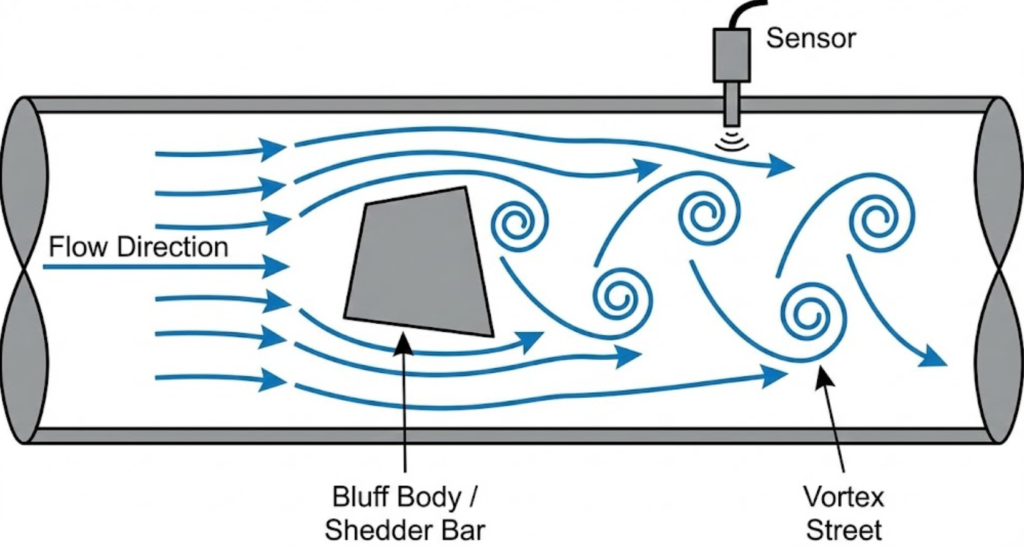
Vortex flow meters operate on the principle of Kármán vortex shedding. When steam flows past a bluff body (shedder bar) in the pipe, alternating vortices are generated downstream. The frequency of vortex shedding is directly proportional to flow velocity, following the Strouhal relationship:
f = St × v / d
Where:
f = Vortex shedding frequency (Hz)
St = Strouhal number (dimensionless constant, typically 0.2–0.3)
v = Flow velocity (m/s)
d = Bluff body width (m)
Technical Specifications (Soaring Instrument LUGB Series):
| Parameter | Specification |
|---|---|
| Measuring Medium | Liquid, gas, steam (dryness > 95%) |
| Medium Temperature | -40°C to +250°C (optional +350°C) |
| Working Pressure | 1.6 MPa, 2.5 MPa, 4.0 MPa (customizable) |
| Accuracy | ±1.0%, ±1.5% |
| Turndown Ratio | 10:1 |
| Steam Velocity Range | 5.0 – 70 m/s |
| Pipe Diameter | DN15 – DN300 (inline) / DN80 – DN2000 (insertion) |
| Minimum Reynolds Number | Re > 20,000 (for stable vortex shedding) |
| Material | 1Cr18Ni9Ti stainless steel |
| Output | 4-20mA, pulse/frequency, RS-485/HART |
| Protection Class | IP65 |
Available Models:
LUGB-Z (Temperature & Pressure Compensation Type): Built-in PT1000 temperature sensor and pressure sensor with online density compensation. Microprocessor performs steam table lookup. Outputs mass flow directly (kg/h).
LUGB-X (Standard LCD Type): Volumetric output only. Requires external temperature/pressure transmitters and flow computer for mass flow calculation.
Advantages:
✅ No moving parts – low maintenance, high reliability
✅ Wide temperature range (up to 350°C)
✅ Suitable for both saturated steam and superheated steam
✅ Direct mass flow output with integrated compensation (LUGB-Z)
✅ Piezoelectric stress sensor with high vibration resistance
Limitations:
⚠️ Minimum velocity required (~5 m/s for steam) to generate stable vortices
⚠️ Requires straight pipe runs (minimum 15D upstream, 5D downstream) — see Vortex Flow Meter Straight Run Requirements
⚠️ Reynolds number must exceed 20,000 for reliable operation
⚠️ Sensitive to severe pipeline vibration (though piezoelectric design minimizes this)
📘 Further Reading: Why Choose Vortex Flow Meters For Steam Applications?
2. Differential Pressure (DP) Flow Meters
Differential pressure flow meters measure the pressure drop across a restriction (primary element) in the pipeline. Based on Bernoulli’s principle, the flow rate is proportional to the square root of the differential pressure.
Common Primary Elements:
Orifice Plate: Most common, lowest cost, compliant with ISO 5167
Venturi Tube: Lower permanent pressure loss (~10-15% of orifice)
Flow Nozzle: Suitable for high-velocity steam, more resistant to erosion
Advantages:
✅ Simple, proven technology (100+ years of industrial use)
✅ Low initial cost
✅ No external power required for primary element
✅ Compliant with ISO 5167 / Engineering ToolBox standards (no calibration required if manufactured to specification)
Limitations:
⚠️ Limited turndown ratio (4:1 to 5:1) due to square-root relationship
⚠️ Orifice edge erosion affects accuracy over time (especially in wet or dirty steam)
⚠️ High permanent pressure loss (40–70% of measured ΔP is not recovered)
⚠️ Long straight pipe run requirements (10–36D upstream, 5D downstream per ISO 5167)
Best For: Applications with stable flow rates within the limited turndown range, such as boiler house steam mains where load is relatively constant.
3. Insertion Type Flow Meters
Insertion vortex flow meters are designed for large diameter pipes (DN200 and above) and retrofit installations where cutting the pipe is impractical.
Soaring Instrument Insertion Vortex Specifications:
| Parameter | Specification |
|---|---|
| Pipe Diameter | DN80 – DN2000 |
| Suitable Media | Superheated steam, saturated steam, gas, liquid |
| Accuracy | ±1.5% to ±2.5% |
| Installation | Hot-tap capable (no process shutdown required) |
| Structure | Split type with ball valve assembly |
Advantages:
✅ Hot-tap installation – install or remove without stopping production
✅ Cost-effective for large pipe diameters (DN200+)
✅ Minimal pressure drop (sensor occupies <5% of flow area)
Limitations:
⚠️ Lower accuracy than inline meters (point velocity vs. full-pipe average)
⚠️ Requires proper insertion depth calculation for accurate measurement
⚠️ Flow profile must be fully developed at measurement point
Best For: Large steam mains, existing pipelines, and applications requiring installation without process interruption.
4. Other Technologies
| Technology | Suitability for Steam | Notes |
|---|---|---|
| Thermal Mass Flow Meter | ⚠️ Limited | Best for dry gas only. Wet steam can damage sensors and cause measurement errors. |
| Ultrasonic Flow Meter | ❌ Not Recommended | Designed for liquids. Steam (gas phase) causes signal attenuation and failure. Suitable only for condensate return measurement. |
| Coriolis Flow Meter | ✅ Excellent Accuracy | Highest accuracy (±0.1–0.5%). Very high cost. Typically used for custody transfer of high-value fluids or natural gas. |
For most industrial steam gas applications, vortex flow meters offer the best balance of accuracy, reliability, and cost.
Temperature & Pressure Compensation: The Key to Accurate Mass Flow
Steam flow meters typically measure volumetric flow (m³/h). However, users need mass flow (kg/h) or energy flow (kJ/h) for billing, process control, and energy management.
Mass Flow Calculation
ṁ = ρ × Q
Where:
ṁ = Mass flow rate (kg/h)
ρ = Steam density (kg/m³) — varies with temperature and pressure!
Q = Volumetric flow rate (m³/h)
Since steam density is not constant, real-time pressure and temperature measurement is essential for accurate mass flow calculation.
Compensation Requirements by Steam Type
| Steam Type | Required Compensation | Sensors Needed |
|---|---|---|
| Saturated Steam | Pressure only | Pressure transmitter |
| Superheated Steam | Temperature + Pressure | PT100/PT1000 + Pressure transmitter |
Energy Flow Calculation (For Billing & Energy Management)
For energy billing or efficiency calculations, you need energy flow (thermal power):
Ė = ṁ × h
Where:
Ė = Energy flow rate (kJ/h or kW)
ṁ = Mass flow rate (kg/h)
h = Specific enthalpy of steam (kJ/kg) — obtained from steam tables based on temperature and pressure
Example:
Saturated steam at 10 bar: h ≈ 2778 kJ/kg
Mass flow = 1000 kg/h
Energy flow = 1000 × 2778 = 2,778,000 kJ/h = 772 kW thermal
How to Ensure Steam Dryness > 95%
For accurate measurement with any steam flow meter, steam quality (dryness fraction) should exceed 95%. Methods to achieve this:
Install a steam separator (cyclone type) upstream of the flow meter
Ensure adequate pipe insulation to minimize condensation
Use drip legs with steam traps at low points in the pipeline
Avoid oversized piping which reduces steam velocity and promotes condensation
Position the meter away from pressure-reducing valves where flash steam may occur
Integrated Compensation Solutions
The Soaring Instrument LUGB-Z Temperature & Pressure Compensation Type vortex flow meter includes:
Built-in PT1000 temperature sensor
Built-in pressure sensor
Microprocessor with IAPWS-IF97 steam table lookup
Direct mass flow output (kg/h) – no external calculations needed
8-digit dual-row LCD display
This integrated approach eliminates the need for separate transmitters and flow computers, reducing installation complexity and cost.
How to Select the Right Steam Flow Meter
Selection Decision Guide
| Application | Recommended Meter | Model/Type |
|---|---|---|
| Boiler steam output monitoring | Vortex (T&P compensated) | LUGB-Z |
| Large diameter steam mains (DN200+) | Insertion vortex | Insertion LUGB |
| Branch steam metering (stable load) | Orifice plate | DP system |
| High-pressure steam (> 4.0 MPa) | Custom high-pressure vortex | LUGB (custom pressure rating) |
| Condensate return metering | Ultrasonic or turbine | Clamp-on ultrasonic / Turbine flow meter |
Key Selection Criteria Comparison
| Factor | Vortex | Orifice/DP | Insertion |
|---|---|---|---|
| Accuracy | ±1.0% | ±1.5 – 2.0% | ±1.5 – 2.5% |
| Turndown Ratio | 10:1 | 4:1 – 5:1 | 10:1 |
| Pressure Loss | Medium | High | Very Low |
| Initial Cost | Medium | Low | Medium-Low |
| Maintenance Cost | Low | High (plate inspection/replacement) | Low |
| Pipe Size Range | DN15 – DN300 | Any | DN200+ |
| Installation Complexity | Medium | High (impulse lines) | Low (hot-tap) |
📘 Further Reading: How to Choose a Vortex Flow Meter for Steam Applications?
Installation Best Practices
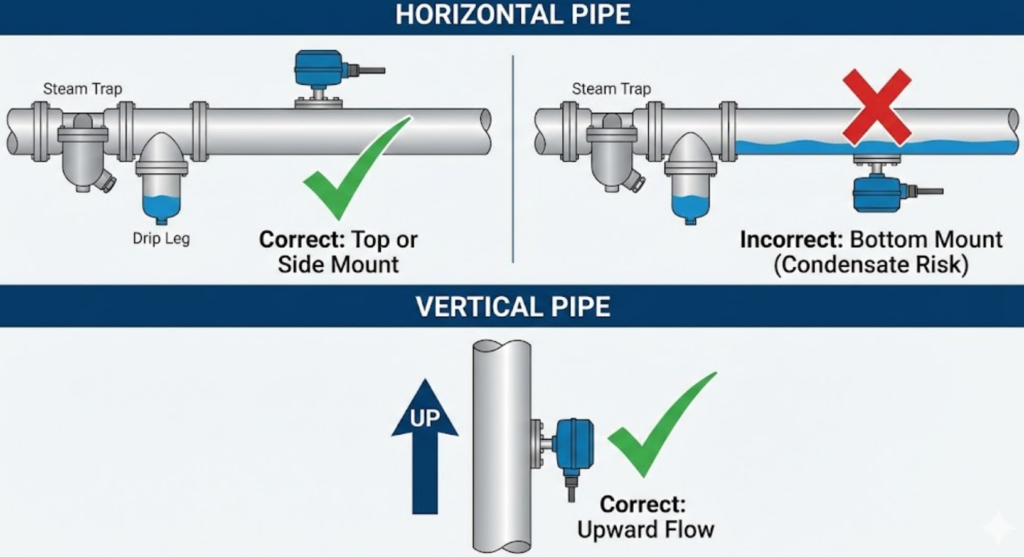
Proper installation is critical for achieving specified accuracy in flow measuring applications.
1. Straight Pipe Run Requirements
| Upstream Disturbance | Upstream Distance | Downstream Distance |
|---|---|---|
| Single 90° elbow | 15D | 5D |
| Two elbows (same plane) | 15D | 5D |
| Two elbows (different planes) | 40D | 5D |
| Partially open valve | 30D | 5D |
| Reducer/Expander | 15D | 5D |
| Pump outlet | 30D | 5D |
D = Pipe internal diameter
2. Orientation Guidelines
Horizontal Pipe: Mount the sensor on the side (3 o’clock or 9 o’clock position) or top of the pipe. Never mount at bottom – condensate accumulation will affect the sensor.
Vertical Pipe: Steam flow should be upward to ensure the pipe remains full and prevent condensate pooling at the sensor.
📘 Vertical Mounting Guide: Vortex Flow Meter Vertical Installation
3. Insulation Requirements
Upstream and downstream piping should be fully insulated to maintain steam quality and prevent condensation.
Transmitter housing should NOT be insulated – allow heat dissipation to protect electronics. Maximum ambient temperature for electronics is typically 55–60°C.
4. Condensate Management
Install a steam separator and steam trap upstream of the flow meter to remove condensate and ensure dry steam.
Ensure the pipeline has a slight slope (1:100 to 1:200) toward drain points.
For saturated steam, a drip leg with automatic steam trap is essential before the meter.
Troubleshooting Common Issues
| Symptom | Probable Cause | Corrective Action |
|---|---|---|
| Reading = 0 at known flow | Flow velocity below minimum threshold (~5 m/s) | Verify flow rate; consider smaller meter size |
| Unstable/fluctuating readings | Wet steam, air bubbles, or insufficient straight run | Check steam dryness; install separator; extend upstream piping |
| Reading higher than expected | Condensate entrained in steam | Install drip leg and steam trap upstream |
| Reading lower than expected | Steam leaking past sensor; deposits on shedder bar | Check installation seal; clean sensor |
| No output signal | Wiring fault; electronics overheated | Check connections; ensure transmitter housing is not insulated |
| Large discrepancy vs. reference meter | Incorrect pipe ID entered; compensation not configured | Verify pipe inner diameter setting; check T&P compensation parameters |
📘 Complete Troubleshooting Guide: What is Vortex Flowmeter Troubleshooting?
Common Applications
Power Generation
Boiler steam production monitoring (efficiency tracking)
Turbine inlet steam metering (heat rate calculation)
Energy efficiency audits and heat balance calculations
Case Example: A 50 MW power plant monitoring boiler output with vortex meters can detect a 2% efficiency drop worth ~$100,000/year in fuel savings.
Chemical & Petrochemical
Process heating steam measurement
Steam cracking operations (olefin production)
Reactor heating control
Food & Beverage
Sterilization and pasteurization (FDA compliance)
CIP (Clean-in-Place) steam monitoring
Cooking, blanching, and retort processes
HVAC & District Heating
Building heating systems
Sub-metering for tenant billing (cost allocation)
District energy networks
Frequently Asked Questions (FAQ)
What is the best flow meter for steam?
Vortex flow meters are the preferred choice for most steam applications due to their no-moving-parts design, high-temperature capability (up to 350°C), and ability to measure both saturated and superheated steam with integrated temperature and pressure compensation.
Can ultrasonic flow meters measure steam?
No. Standard ultrasonic flow meters are designed for liquids and cannot accurately measure steam (gas phase). Ultrasonic technology is suitable only for condensate return measurement, not live steam.
Why does steam require temperature and pressure compensation?
Steam is a compressible fluid whose density varies significantly with temperature and pressure. To convert volumetric flow (m³/h) to mass flow (kg/h), real-time density calculation is required—this is only possible with temperature and/or pressure compensation.
How accurate are steam flow meters?
Vortex flow meters: ±1.0% to ±1.5% of reading
Differential pressure (orifice): ±1.5% to ±2.0% of reading
Insertion type: ±1.5% to ±2.5% of reading
Coriolis: ±0.1% to ±0.5% of reading (highest cost)
Learn more: What is the Accuracy of a Vortex Flow Meter?
What is the minimum flow velocity for a vortex steam flow meter?
Approximately 5 m/s for steam applications. Below this velocity, vortex shedding becomes unstable and the meter may read zero or produce erratic signals.
Conclusion
Selecting the right steam flow meter requires understanding your steam type (saturated vs superheated), operating conditions, and accuracy requirements.
Key Takeaways:
Vortex flow meters are the preferred technology for most steam applications due to their no-moving-parts design, high-temperature capability, and ability to handle both saturated and superheated steam.
For accurate mass flow measurement, temperature and pressure compensation is essential. The Soaring Instrument LUGB-Z with integrated T&P compensation provides direct mass flow output—no external flow computer needed.
Ensure steam dryness > 95% by installing separators, drip legs, and steam traps upstream of the meter.
Proper installation – including adequate straight runs (15D/5D minimum), correct orientation, and condensate management – is critical for achieving rated accuracy.
For large diameter pipes (DN200+), insertion type vortex meters offer a cost-effective solution with hot-tap installation capability.
Get a Free Steam Measurement Assessment
Our engineering team is available to review your steam measurement requirements and recommend the optimal meter configuration – including sizing, materials, and output options. We provide:
Application analysis
Meter sizing calculations
Installation recommendations
Quotation and lead time
Request Free Steam Meter Assessment | View Vortex Steam Flow Meter Specifications