
Vortex Flow Meter
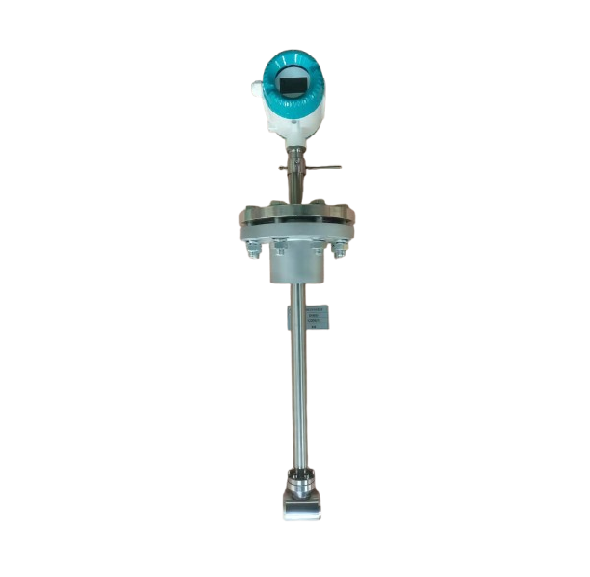
Product Description
✓ IP65 Protection · ✓ CE Compliant · ✓ Gas / Steam / Liquid Compatible
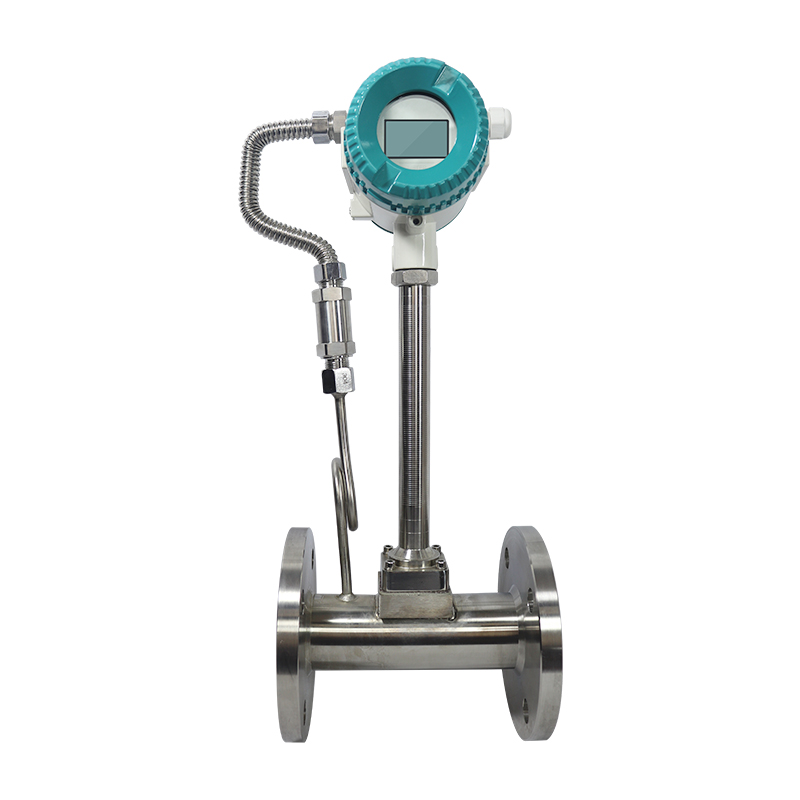
Pipe Size: DN15 – DN300 (Flange/Wafer) · DN80 – DN2000 (Insertion)
Accuracy: ±1.0% · ±1.5%
Medium Temp: -40°C to +250°C (optional +350°C)
Medium Pressure: 1.6 / 2.5 / 4.0 MPa (customizable)
Flow Velocity: Liquid: 0.4–7 m/s · Gas: 4–60 m/s · Steam: 5–70 m/s
Power Supply: 24VDC · 3.6VDC (battery)
Output: 4–20 mA | Pulse | RS485
Lead Time: 7–14 working days · MOQ: 1 Unit
Engineer replies within 24 hours · Free technical consultation
Technical Specifications
Performance
| Parameter | Specification |
|---|---|
| Measurement Principle | Karman vortex shedding |
| Measuring Medium | Liquid, gas, steam (single-phase). Saturated steam: dryness > 95% required. |
| Accuracy | ±1.0% · ±1.5% (selectable) |
| Turndown Ratio | 10:1 |
| Flow Velocity Range | Liquid: 0.4–7 m/s | Gas: 4.0–60 m/s | Steam: 5.0–70 m/s |
| Pipe Size — Inline (Flange / Wafer) | DN15 – DN300 |
| Pipe Size — Insertion Type | DN80 – DN2000 |
| Medium Temperature | -40°C to +250°C (optional: up to +350°C) |
| Medium Pressure | 1.6 MPa · 2.5 MPa · 4.0 MPa (customizable) |
| Body Material | 1Cr18Ni9Ti (stainless steel) |
| Resistance Coefficient | Cd < 2.4 |
Electrical & Signal
| Parameter | Specification |
|---|---|
| Power Supply | 24VDC · 3.6VDC (lithium battery option) |
| Output Signal | 4–20 mA | Pulse | RS485 |
| Display | Double-row LCD, 8-digit totalizer |
| Protection Class | IP65 |
| Ambient Temperature | -40°C to +55°C |
| Relative Humidity | ≤ 85% RH |
Variants Available
| Model | Key Feature | Best For |
|---|---|---|
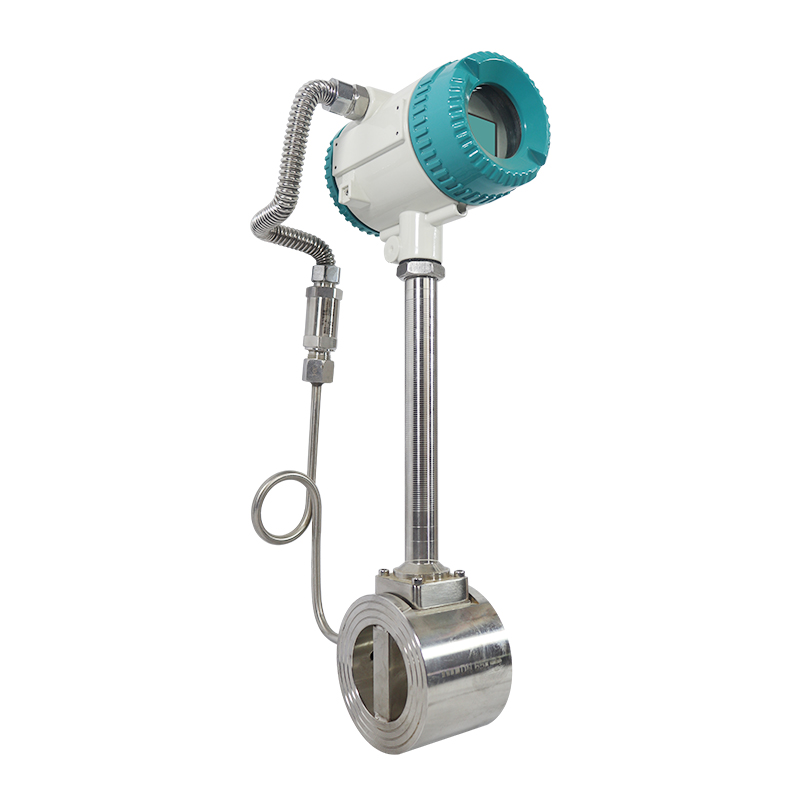
| LUGBSR-Z (Temp & Pressure Compensated) | Built-in temperature & pressure compensation; online density correction | Steam · Gas with variable pressure/temp |
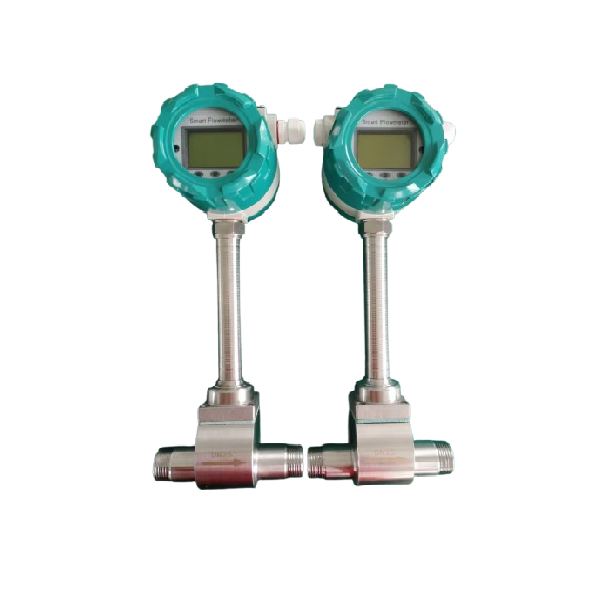
| LUGBSR-X (Standard LCD) | Online temperature compensation; fixed-value density compensation | Liquid · Gas at stable conditions |
| Insertion Type | Hot-tap installation; DN80–DN2000 | Large pipes · Retrofit without shutdown |
Why Choose a Vortex Flow Meter?
A vortex flow meter is built around the Karman vortex principle: as fluid passes a bluff body inside the pipe, it sheds alternating vortices at a frequency directly proportional to flow velocity. There are no moving mechanical parts to wear out and no consumable components — this is why vortex meters consistently outperform turbine meters in longevity for steam and high-temperature gas applications.
Unlike differential pressure meters (orifice plates, venturis), a vortex meter’s output frequency is independent of fluid density, pressure, viscosity, and temperature — parameters that must be compensated in DP systems. This makes vortex flow measurement inherently simpler and more stable across varying process conditions.
- No moving parts — nothing to wear, seize, or require mechanical maintenance
- True multi-fluid capability — one instrument design handles liquid, gas, and steam without changing the sensor body
- Wide temperature range — piezoelectric stress sensor operates from -40°C to +250°C (optional +350°C), covering saturated and superheated steam
- Low pressure loss — resistance coefficient Cd < 2.4, significantly lower than orifice plates
- Digital-ready output — 4–20 mA, pulse, RS485 outputs integrate directly with SCADA, DCS, and PLC systems
- Long-term parameter stability — instrument K-factor does not drift over time under normal operating conditions
For steam metering applications, a vortex flow meter with temperature and pressure compensation (LUGBSR-Z model) calculates mass flow and energy consumption in real time — eliminating the need for separate DP transmitters and flow computers.
Typical Applications
🔧 Steam Metering — Saturated & Superheated Steam
The Challenge: Steam distribution networks in power plants, chemical plants, and manufacturing facilities need accurate metering at each consumption point. Steam is compressible, and its density varies with both temperature and pressure — traditional DP meters require complex compensation and frequent maintenance of impulse lines.
Why This Meter: The LUGBSR-Z vortex flow meter with built-in temperature and pressure compensation measures saturated and superheated steam mass flow directly. The piezoelectric sensor withstands continuous operation at up to 250°C (350°C on request). No impulse lines. No condensate pots. No remote seals. Installation is wafer or flange type on DN15–DN300 pipes; insertion type available for DN80–DN2000 headers.
🔧 Compressed Air & Industrial Gas
The Challenge: Compressed air is one of the most expensive utilities in manufacturing — leaks and overconsumption are common but difficult to quantify without per-circuit metering. Gas flow must be measured at varying line pressures without recalibrating the meter.
Why This Meter: Vortex meters are ideal for compressed air and industrial gases (nitrogen, oxygen, CO₂, natural gas). Flow velocity range of 4–60 m/s covers typical compressed air velocities. The meter reads volumetric flow at line conditions; the LUGBSR-Z model adds pressure/temperature compensation to convert to standard volume (Nm³/h) for accurate cost allocation.
🔧 Liquid Flow — Chemical, Petroleum & Water
The Challenge: Process lines handling clean liquids — cooling water, light hydrocarbons, solvents, chemical feedstocks — need a meter that handles flow velocities from 0.4 m/s upward without the electrode limitations of electromagnetic meters.
Why This Meter: For liquids, vortex meters work on any fluid regardless of conductivity — including petroleum products and non-conductive chemicals where electromagnetic meters cannot be used. Liquid flow velocity range 0.4–7 m/s; accuracy ±1.0%.
🔧 Large-Diameter Pipes — Insertion Type
The Challenge: Inline meters on DN500+ pipes require expensive flanged fittings and process shutdowns for installation or replacement.
Why This Meter: The insertion vortex flow meter covers DN80–DN2000 with hot-tap installation capability. Accuracy ±1.5%–±2.5%; ideal for large-diameter steam headers, gas mains, and cooling water circuits where an inline flange connection is impractical.
How a Vortex Flow Meter Works
The operating principle is based on the Karman vortex street phenomenon. When a fluid flows past a bluff body (the shedder bar) inserted into the pipe, alternating vortices are shed from each side of the bluff body in a regular, repeating pattern. The frequency of vortex shedding is linearly proportional to the fluid velocity:
f = St × V / d — where f = vortex frequency, St = Strouhal number (constant for a given geometry), V = fluid velocity, d = bluff body width
A piezoelectric stress sensor embedded in the bluff body detects the alternating pressure fluctuations caused by vortex shedding. The transmitter counts these pulses, calculates flow velocity, and multiplies by the pipe cross-sectional area to produce volumetric flow rate. The Strouhal number is stable across a wide Reynolds number range — which is why vortex meter K-factor does not change with fluid density, viscosity, pressure, or temperature.
Key Advantages of the Piezoelectric Sensing Method
- Operates at high temperatures without signal degradation — piezoelectric crystals maintain output up to 250°C
- Immune to thermal drift that affects capacitive sensors in competing designs
- High sensitivity to low-amplitude vortex signals — extends the low-flow cutoff point
- Soaring’s differential pressure detection circuit adds isolation, shielding, and filtering — reducing the vibration susceptibility that affects some competing vortex designs
Can We Meet Your Requirements?
| Requirement | Capability | Status |
|---|---|---|
| Steam metering (saturated & superheated) | Standard — LUGBSR-Z with T&P compensation | ✅ Standard |
| Gas / compressed air | Standard — flow range 4–60 m/s | ✅ Standard |
| Liquid (water, chemicals, petroleum) | Standard — flow range 0.4–7 m/s | ✅ Standard |
| Pipe DN15–DN300 (inline) | Flange or wafer connection | ✅ In stock |
| Pipe DN80–DN2000 (large diameter) | Insertion type — hot-tap available | ✅ Available |
| Temperature up to 250°C | Standard piezoelectric sensor range | ✅ Standard |
| Temperature up to 350°C | Optional high-temperature configuration | ✅ Available |
| Pressure up to 4.0 MPa | Standard pressure rating | ✅ Standard |
| Pressure > 4.0 MPa | Customizable — discuss requirements | ⚠️ Requires review |
| Mass flow / standard volume (Nm³/h) | LUGBSR-Z model with T&P compensation | ✅ Available |
| Battery-powered (no external power) | 3.6VDC lithium battery option | ✅ Available |
| SCADA / DCS integration | 4–20mA, RS485, Pulse | ✅ Standard |
| Slurries / high-solids fluids | Not suitable — solids foul bluff body | ❌ Not recommended |
| Very low flow velocity (<0.4 m/s liquid) | Below vortex shedding threshold | ❌ Not suitable |
| Non-full pipe conditions | Requires fully filled pipe | ❌ Not suitable |
Our Capabilities & Boundaries
WHAT WE DO:
- Vortex flow measurement for gas, steam, and liquid in DN15–DN300 inline and DN80–DN2000 insertion configurations
- Steam mass flow metering with real-time temperature and pressure compensation (LUGBSR-Z)
- High-temperature applications up to 250°C standard, 350°C optional
- Integration with SCADA, DCS, and PLC via 4–20mA, RS485, or pulse output
- Battery-powered remote installation with 3.6V lithium option
WHAT WE DON’T DO:
- Slurries or abrasive fluids → Use our electromagnetic flow meter
- Non-conductive liquid at very low velocities → Consider turbine flow meter
- Custody transfer at ±0.2% → Requires Coriolis technology
- Portable / temporary measurement → Contact us for portable options
Ordering Information
| Item | Details |
|---|---|
| Standard Package | Vortex flow meter body + transmitter (LUGBSR-X or LUGBSR-Z) + connection hardware |
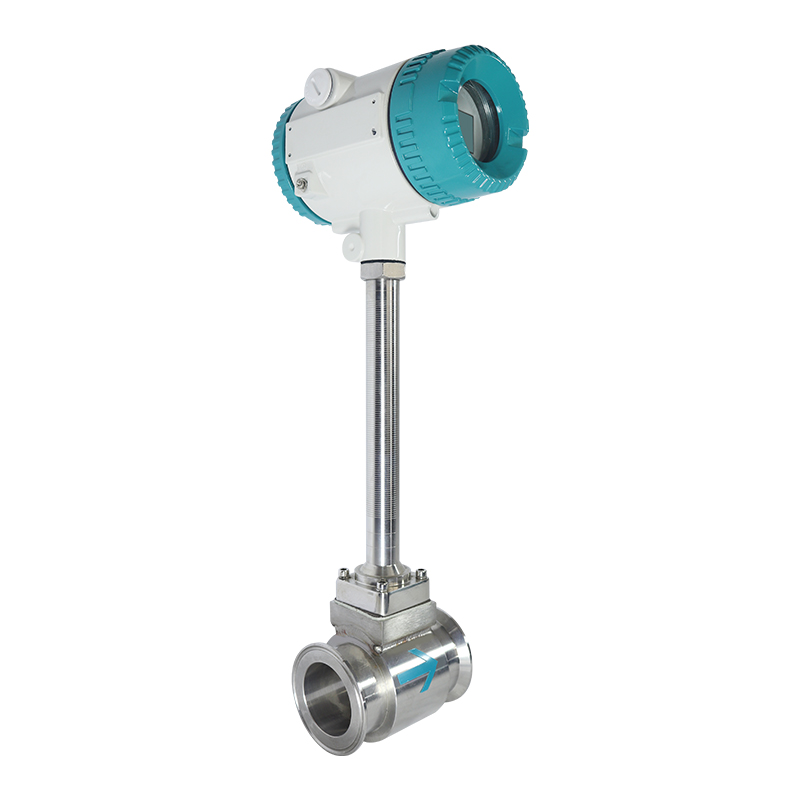
| Connection Type | Wafer (clamp) or Flange — specify at order |
| Compensation Option | LUGBSR-Z: temperature + pressure compensation for steam/gas mass flow |
| High-Temp Option | Up to 350°C — specify at order |
| MOQ | 1 unit |
| Standard Lead Time | 7–14 working days |
| Rush Order | Available — contact sales for expedited delivery |
| Payment Terms | T/T |
| Warranty | 12 months from shipment date |
| Packaging | Export carton — ISPM 15 compliant wooden crate available on request |
Frequently Asked Questions
What is a vortex flow meter used for?
A vortex flow meter measures the volumetric or mass flow rate of gases, steam, and liquids in closed pipes. It is most commonly used for steam metering (saturated and superheated), compressed air and industrial gas measurement, and clean liquid flow measurement in chemical, petrochemical, and utility applications. It is not suitable for slurries, highly viscous fluids, or non-full-pipe conditions.
How does a vortex flow meter work?
A vortex flow meter works on the Karman vortex shedding principle. A bluff body (shedder bar) is placed in the flow stream; as fluid passes it, alternating vortices are shed at a frequency proportional to flow velocity. A piezoelectric sensor detects these pressure fluctuations. The transmitter converts the frequency to flow rate. Because the Strouhal number is constant for a given geometry, the measurement is independent of fluid density, viscosity, pressure, and temperature.
What pipe sizes are available for vortex flow meters?
Soaring vortex flow meters are available in DN15 to DN300 for inline (flange or wafer) installation, and DN80 to DN2000 for insertion-type installation. The insertion type allows hot-tap installation on large-diameter pipes without process shutdown.
Can a vortex flow meter measure steam?
Yes. Vortex flow meters are one of the most widely used technologies for steam flow measurement. The LUGBSR-Z model includes built-in temperature and pressure compensation to calculate steam mass flow and energy consumption in real time. It handles saturated steam (dryness > 95%) and superheated steam up to 250°C standard, 350°C optional. Steam flow velocity range is 5.0–70 m/s.
What is the accuracy of a vortex flow meter?
Soaring vortex flow meters achieve ±1.0% or ±1.5% accuracy (selectable at order). The insertion type achieves ±1.5%–±2.5%. Accuracy is maintained across a 10:1 turndown ratio within the specified flow velocity range.
What is the difference between a vortex flow meter and an electromagnetic flow meter?
The key difference is the applicable media. Electromagnetic flow meters only work on electrically conductive liquids — they cannot measure gas or steam. Vortex flow meters measure gas, steam, and liquid regardless of electrical conductivity, but are not suitable for slurries or very low velocities. For clean liquid applications, both technologies can be used; the choice depends on conductivity, flow velocity range, and temperature requirements.
How do I select the right vortex flow meter?
To select the correct vortex flow meter, provide: (1) fluid type — liquid, gas, or steam; (2) pipe diameter; (3) flow velocity range or volumetric flow range; (4) medium temperature and pressure; (5) required output — analog, pulse, or digital protocol. For steam applications, specify whether temperature and pressure compensation is needed for mass flow calculation. Contact our engineers with these parameters for a recommendation and quote within 24 hours.
Get Your Custom Quote in 24 Hours
We supply vortex flow meters to process engineers, plant operators, and instrumentation distributors across 65+ countries. Whether you need a standard DN50 steam meter or a DN1000 insertion unit for a large gas header, our engineering team will review your application and respond within 24 hours.
- Engineer reviews your application parameters and replies within 24 hours
- Free 30-minute technical consultation — no obligation
- Detailed proposal with specifications and pricing within 3 business days
- 📧 [email protected]
- 📞 0086-13585991410
- 🌐 Contact Us Online