
High Accuracy Type
Ultrasonic Flow Meter
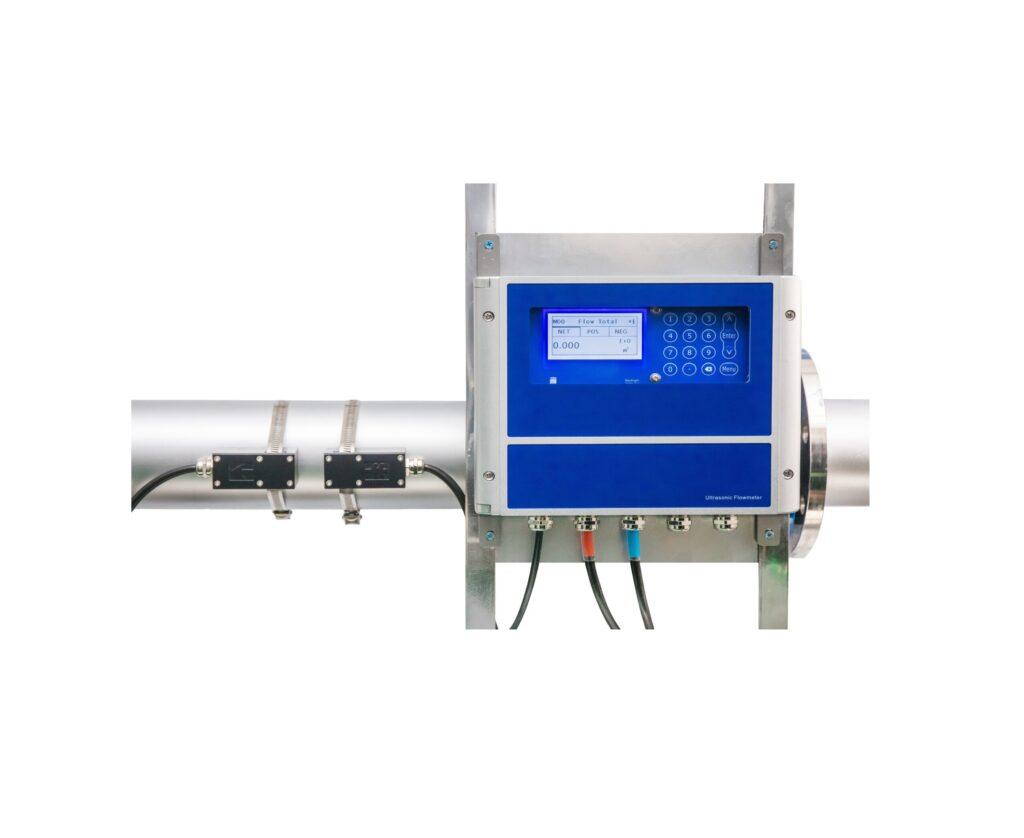
Product Description
✓ IP68 Transducers · ✓ IP65 Transmitter · ✓ CE Compliant
Channels: Single & Dual Channel available
Pipe Size: DN25 – DN5000 (1″ – 200″)
Flow Range: ±0.03 m/s to ±12 m/s
Sensor Type: Clamp-On & Insertion
Power: DC 10–36V / AC 90–245V
Output: 4–20 mA | RS485 Modbus | HART (Dual Channel opt.)
Installation: Wall Mounted — No Pipe Cutting (Clamp-On)
Lead Time: 7 days · MOQ: 1 Unit
Engineer replies within 24 hours · Free technical consultation
Technical Specifications
Performance — Single Channel vs Dual Channel
| Parameter | Single Channel (SR6300S) | Dual Channel (SR6300S-D) |
|---|---|---|
| Measurement Principle | Transit-time difference | |
| Transducer Pairs | 1 pair per pipe | 2 pairs on the same pipe |
| Flow Velocity Range | ±0.03 m/s to ±12 m/s (±0.09 ft/s to ±40 ft/s) | |
| Accuracy | ±0.5% of reading (for flow ≥ 0.46 m/s) | ±0.5% of reading (for flow ≥ 0.46 m/s) |
| Repeatability | 0.1% of measured value | 0.15% of measured value |
| Linearity | ±0.5% | |
| Pipe Size Range | DN25–DN5000 (1″–200″) | |
Wall-Mounted Transmitter (Common to Both Models)
| Parameter | Specification |
|---|---|
| Display | 240×128 backlit LCD, 4-line readout |
| Analog Output | 4–20 mA, max load 750Ω |
| Pulse Output | 0–9999 Hz, OCT (min. and max. frequency adjustable) |
| Relay Output | SPST, max 1 Hz (1A@125VAC or 2A@30VDC) |
| Communication | Single: RS232/RS485 Modbus Dual: RS485 Modbus + HART (optional) |
| Data Logger | TF card (up to 32 GB) |
| Power Supply | DC 10–36V / AC 90–245V (48–63 Hz) |
| Operating Temperature | -40°C to +60°C (-40°F to +140°F) |
| Humidity | Up to 99% RH, non-condensing |
| Protection Rating | IP65 |
Transducer Options
| Model | Type | Pipe Size | Temperature Range | Application |
|---|---|---|---|---|
| TT02 | Clamp-On | DN25–DN5000 | -40°C to +80°C | Standard — water, cooling systems |
| TT03 | Clamp-On | DN25–DN5000 | 0°C to +130°C | Medium-temperature process fluids |
| TT05 | Insertion | DN25–DN5000 | -40°C to +130°C | Permanently installed insertion probe |
All transducers feature IP68 waterproof protection with encapsulated design and double-shielded signal cables. Standard cable length: 9 m (30 ft). Maximum extension: Single Channel up to 305 m (1000 ft); Dual Channel up to 274 m (900 ft).
Optional: Energy Meter Function
Both single and dual channel models can function as an energy meter (BTU meter) when paired with the RTD module and PT1000 clamp-on temperature sensors. This enables continuous measurement of heat and cold consumption in:
- Central heating and hot water distribution pipelines
- Air-conditioning and refrigeration chilled water systems
- District energy networks and HVAC building management
Single Channel vs Dual Channel — Which Do You Need?
Both configurations use the same wall-mounted transmitter platform. The difference is in how many transducer pairs are installed on your pipe — and what that means for your measurement.
| Consideration | Single Channel | Dual Channel |
|---|---|---|
| Sensor Setup | 1 pair of transducers on one pipe | 2 pairs of transducers on the same pipe |
| Signal Averaging | Single path measurement | Dual path — averages two independent readings for improved stability |
| Best For | Standard monitoring, most industrial applications | Critical measurements requiring maximum stability and redundancy |
| Typical Use Cases | Water distribution, cooling systems, HVAC metering, process monitoring | Revenue metering, large-diameter mains, custody allocation, R&D labs |
| HART Communication | Not available | Optional |
| Cost | Lower (fewer transducers) | Higher (additional transducer pair + installation) |
When to choose Dual Channel:
- The pipe diameter is large (DN500+) where flow profile asymmetry is more likely
- You need maximum measurement confidence for billing, revenue, or compliance
- The application requires HART protocol for integration with advanced asset management systems
- You want built-in redundancy — if one channel has a transient issue, the other continues measuring
When Single Channel is sufficient:
- Standard process monitoring where ±0.5% accuracy already exceeds requirements
- Budget-conscious installations that still need high accuracy
- Pipe sizes under DN500 where flow profiles are typically well-developed
What Makes This a “High Accuracy” Ultrasonic Flow Meter?
Not all ultrasonic flow meters deliver the same level of measurement accuracy. Many low-cost clamp-on meters on the market claim ±2% to ±5% accuracy under ideal conditions — and perform worse in real installations. This precision ultrasonic flow meter is engineered differently.
Three design features set it apart:
- ±0.5% accuracy of reading — Not ±0.5% of full scale, but of the actual reading. This means the measurement stays proportionally accurate whether you are at 10% flow or 100% flow. The single channel delivers 0.1% repeatability; the dual channel adds path-averaging for enhanced stability in challenging flow profiles. This level of precision is critical for trade metering, process optimization, and energy billing applications where every percentage point affects cost.
- Dual-path averaging (Dual Channel) — The dual channel model installs two transducer pairs on the same pipe. By averaging two independent acoustic paths, it compensates for flow profile asymmetry caused by bends, valves, or large pipe diameters — delivering more representative measurements where a single path would see only part of the flow profile.
- Clamp-on non-invasive design with IP68 transducers — The encapsulated transducer design with double-shielded cables ensures long-term signal integrity. IP68-rated transducers operate reliably in wet, submerged, or harsh environments where exposed sensors would fail.
Want to understand the factors that affect ultrasonic flow meter accuracy? Read: How Accurate Are Ultrasonic Flow Meters?
How It Works — Transit-Time Measurement Principle
This wall mounted ultrasonic flow meter uses the transit-time difference method to measure the time it takes for ultrasonic waves to travel between two clamp-on transducers mounted on the outside of the pipe wall.
Here is how the measurement principle works:
- Two transducers are mounted on the pipe — one upstream and one downstream
- Each transducer alternately sends and receives sound waves through the liquid flows inside the pipe
- The signal traveling with the flow arrives faster than the signal traveling against the flow
- The meter calculates the time difference and converts it to flow velocity, then to volumetric flow rate
No moving parts. No contact with the fluid. No pressure drop. No wear. The clamp-on installation method means you never cut into the pipe — the transducers mount on the outside of the pipe wall, and ultrasonic waves pass through the wall material to reach the liquid.
Transducer Mounting Methods
The correct mounting configuration depends on your pipe size and material:
| Method | Signal Path | Best For | Typical Pipe Size |
|---|---|---|---|
| V-Method | Both transducers on same side; signal bounces off opposite wall | Standard choice for most pipe sizes | DN25–DN500 |
| Z-Method | Transducers on opposite sides; signal crosses directly | Large pipes or thick-walled pipes | DN500+ |
For a complete installation walkthrough, see: How to Install a Clamp-On Ultrasonic Flow Meter: Step-by-Step Guide.
Typical Applications
🔧 Trade Metering & Billing
The Challenge: Water utilities and energy companies need continuous, accurate flow measurement for billing and revenue metering. Every percentage of measurement error directly affects revenue or cost allocation.
Why This Meter: The ±0.5% accuracy and 0.1% repeatability exceed trade metering requirements for liquid flows in pipe sizes from DN25 to DN5000. The dual channel option provides additional measurement confidence for revenue-critical applications. Non-invasive clamp-on installation eliminates the need to shut down the pipeline for meter installation or replacement.
🔧 Industrial Process Control
The Challenge: Chemical plants, pharmaceutical facilities, and refineries need reliable flow metering for process control — often on stainless steel or specialized alloy piping carrying clean liquids at elevated temperatures.
Why This Meter: With transducers rated up to 130°C (TT03/TT05 models) and compatibility with stainless steel, carbon steel, and PVC pipes, this meter handles most industrial process fluids. The dual channel option with optional HART protocol provides advanced integration with DCS and SCADA systems. Standard 4-20mA and RS485 Modbus outputs also available.
🔧 HVAC Energy Metering
The Challenge: Building operators need to measure chilled water and hot water flow rates and thermal energy consumption for billing tenants, optimizing HVAC efficiency, or verifying system performance.
Why This Meter: Add the optional RTD module and PT1000 temperature sensors to convert this wall mounted ultrasonic flow meter into a clamp-on BTU energy meter. Measure heat and cold consumption without cutting into the piping — see: Key Applications of Clamp-On Ultrasonic BTU Meters.
🔧 Water Utility Monitoring
The Challenge: Municipal water networks need permanent flow monitoring at distribution nodes, pump stations, and treatment plant inlets/outlets — often on large-diameter mains where inline meters are prohibitively expensive.
Why This Meter: The DN25–DN5000 range covers virtually all distribution pipe sizes, including large-diameter trunk mains. The dual channel option is ideal for large pipes (DN500+) where flow profile asymmetry makes single-path measurement less reliable. Wall-mounted design provides permanent, continuous monitoring with IP65/IP68 protection for outdoor or underground installations. Optional bi-directional measurement capability detects reverse flows that indicate cross-connections or valve failures.
Can We Meet Your Requirements?
| Requirement | Capability | Status |
|---|---|---|
| Pipe Size DN25–DN5000 | Standard transducers (Clamp-On or Insertion) | ✅ In stock |
| Single Channel (1 pair) | Standard configuration, ±0.5% accuracy | ✅ Standard |
| Dual Channel (2 pairs) | Enhanced stability for critical applications | ✅ Available |
| Clean water / Cooling water | Standard application | ✅ Standard |
| Oil / Petroleum liquids | Compatible with transit-time method | ✅ Available |
| Chemical liquids | Confirm acoustic compatibility | ⚠️ Requires review |
| High temperature (up to 130°C) | TT03 / TT05 transducer models | ✅ Available |
| Accuracy ±0.5% | Standard specification (both models) | ✅ Standard |
| HART Communication | Dual Channel model (optional) | ✅ Available |
| Energy metering (BTU) | Optional RTD module + PT1000 | ✅ Available |
| SCADA / DCS integration | 4-20mA, RS485, HART (optional on Dual) | ✅ Standard |
| Slurries / High-solids fluids | Not suitable for transit-time | ❌ Not recommended |
| Gas / Steam | Liquid measurement only | ❌ Not suitable |
| Non-full pipe conditions | Requires fully filled pipe | ❌ Not suitable |
Our Capabilities & Boundaries
WHAT WE DO:
- Permanent wall-mounted clamp-on liquid flow measurement using transit-time technology for clean liquids
- Non-invasive installation — clamp transducers on the outside of any pipe from DN25 to DN5000
- Single channel or dual channel configurations for different accuracy/stability requirements
- Continuous monitoring with 4-20mA, RS485 Modbus, and optional HART output (Dual Channel) for SCADA integration
- Optional energy meter function with PT1000 sensors for heating/cooling BTU measurement
- High-temperature applications up to 130°C with TT03/TT05 transducers
WHAT WE DON’T DO:
- Gas or steam flow → Use our vortex flow meter for steam, or thermal mass flow meter for gas
- Slurries or high-solids fluids → Signal scatter from particles makes transit-time unreliable; select the electromagnetic flow meter instead
- Custody transfer at ±0.2% accuracy → This requires Coriolis technology
- Temporary or portable measurement → See our portable ultrasonic flow meter for field work and spot-checking
Installation Guide
The wall-mounted installation method for this clamp on ultrasonic flow meter high accuracy is straightforward. Because the transducers mount on the outside of the pipe, there is no pipe cutting, no welding, and no process shutdown required.
Straight Run Requirements
To achieve the specified ±0.5% measurement accuracy, adequate straight pipe runs upstream and downstream of the measurement point are essential:
| Upstream Condition | Upstream Straight Run | Downstream Straight Run |
|---|---|---|
| Standard (elbow, bend) | ≥10D | ≥5D |
| After valve | ≥30D | ≥10D |
| After pipe expansion | ≥30D | ≥5D |
| After pump | ≥20D | ≥10D |
D = pipe inner diameter. For more details, see: Pipe Requirements for Ultrasonic Flow Meter Installation.
Transducer Positioning
- Install on a horizontal pipe at the 3 o’clock or 9 o’clock position (pipe sides) to avoid air pockets at the top or sediment at the bottom
- On vertical pipes, install on an upward flow section to ensure the pipe is fully filled
- Apply coupling compound between transducers and pipe wall — eliminate all air gaps for clean signal transmission
The transmitter mounts on a nearby wall or panel with standard brackets. Signal cables (standard 9 m) connect the transmitter to the clamp-on transducers. For installations requiring longer cable runs, cables can be extended up to 300 m.
For a complete step-by-step guide, read: How to Install a Clamp-On Ultrasonic Flow Meter.
Ordering Information
| Item | Details |
|---|---|
| Single Channel Package | Wall-mount transmitter + 1 pair clamp-on transducers (TT02, TT03, or TT05) |
| Dual Channel Package | Wall-mount transmitter + 2 pairs clamp-on or insertion transducers on the same pipe |
| Optional Add-On | RTD module + PT1000 temperature sensors (energy meter function) |
| Optional Add-On | HART communication module (Dual Channel only) |
| MOQ | 1 unit |
| Standard Lead Time | 7 days |
| Rush Order | Available — contact sales for expedited delivery |
| Payment Terms | T/T |
| Warranty | 12 months from shipment date |
| Packaging | Individual carton with foam protection, ISPM 15 compliant for export |
| Included Documentation | Factory calibration certificate, operation manual |
Frequently Asked Questions
What is the accuracy of this high accuracy ultrasonic flow meter?
Both single and dual channel models deliver ±0.5% accuracy of reading (for flow velocities ≥0.46 m/s) with ±0.5% linearity. The single channel achieves 0.1% repeatability; the dual channel offers 0.15% repeatability with enhanced stability through dual-path averaging. Factory-matched transducers (≤2 nanosecond matching) ensure that measurement accuracy is maintained across the full flow range. For a deeper understanding of accuracy factors, see: How Accurate Are Ultrasonic Flow Meters?
What pipe sizes are compatible with this wall mounted ultrasonic flow meter?
Both single and dual channel models support DN25 to DN5000 (1″ to 200″) using clamp-on or insertion transducers. The meter works on carbon steel, stainless steel, PVC, copper, and other compact material pipes. The key requirement is that the pipe wall must transmit sound waves — lined or heavily corroded pipes may need special consideration. For large pipes (DN500+), the dual channel option is recommended to compensate for flow profile asymmetry. Read more: Pipe Requirements for Ultrasonic Flow Meter Installation.
Can this precision ultrasonic flow meter measure flow in both directions?
Yes. The meter supports optional bi-directional flow measurement across the full velocity range of ±0.03 m/s to ±12 m/s. When enabled, built-in totalizers separately track positive flow, negative flow, and net flow — useful for detecting reverse flows in distribution networks or verifying loop direction in HVAC systems. Contact our team to confirm availability for your specific configuration.
What is the difference between clamp-on and insertion transducers?
Clamp-on transducers mount on the outside of the pipe wall — no pipe penetration required. This is the standard installation method for most applications. Insertion transducers (TT05 model) are inserted into the pipe through a fitting, providing direct contact with the fluid for stronger signal quality in challenging conditions such as very large pipes or acoustically difficult media. Both types work with the same wall-mounted transmitter. Learn more: Key Differences Between Inline and Clamp-On Ultrasonic Flow Meters.
Can this clamp on ultrasonic flow meter high accuracy measure thermal energy (BTU)?
Yes. By adding the optional RTD module and PT1000 clamp-on temperature sensors, this meter becomes an energy meter capable of continuously measuring heat and cold consumption in heating and cooling pipelines. The PT1000 sensors use high-temperature resistance cables for reliable long-term monitoring. Learn more: How Do Clamp-On Ultrasonic Flow Meters Measure Energy?
Does this flow meter work with non-conductive liquids?
Yes. Unlike electromagnetic flow meters that require conductive fluids, this ultrasonic meter works by transmitting sound waves through the liquid — conductivity is irrelevant. It measures deionized water, oils, glycol solutions, solvents, and other clean liquids regardless of electrical conductivity. For a full compatibility guide, see: What Fluids Can Ultrasonic Flow Meters Measure?
What maintenance is required for a wall mounted ultrasonic flow meter?
Minimal maintenance. Because there are no moving parts and the clamp-on transducers have no contact with the fluid, there is no wear, no fouling, and no need for periodic sensor replacement. Recommended maintenance includes: (1) periodic inspection of transducer coupling to ensure firm contact with the pipe wall, (2) checking cable connections for wear, (3) verifying zero calibration annually. Read more: What’s the Best Way to Maintain Your Ultrasonic Flow Meter?
What is the difference between a wall-mounted and portable ultrasonic flow meter?
Wall-mounted meters are permanently installed for continuous, long-term flow metering with hardwired power (DC/AC) and output connections to SCADA/DCS systems. Portable meters are battery-powered handheld units designed for temporary measurement, spot-checking, and field surveys. Both use the same transit-time measurement principle. If you need portable measurement, see our portable ultrasonic flow meter.
What is the difference between single channel and dual channel ultrasonic flow meters?
A single channel ultrasonic flow meter uses one pair of transducers to measure flow along a single acoustic path. A dual channel model uses two pairs of transducers on the same pipe, averaging two independent paths. The dual channel configuration provides better signal stability, compensates for flow profile asymmetry in large or disturbed pipes, and offers built-in redundancy. Both share the same wall-mounted transmitter platform, same ±0.5% accuracy specification, and the same transducer options. Choose dual channel when measurement reliability is critical — for example, in revenue metering, large-diameter mains (DN500+), or applications requiring HART protocol.
Get Your Custom Quote in 24 Hours
At Soaring Instrument, we manufacture wall-mounted, portable, and insertion ultrasonic flow meters in-house. We’ll recommend the right configuration — single channel or dual channel, clamp-on or insertion transducers — based on your actual application, not just the product we happen to sell.
Tell us your pipe size, pipe material, medium type, temperature range, and whether you need standard monitoring or high-confidence measurement. Our engineering team responds with a technical recommendation and pricing within 24 hours.
- 📧 [email protected]
- 📞 0086-13585991410
- 🌐 Contact Us Online
What Happens After You Submit?
- Step 1: Engineer reviews your requirements and replies within 24 hours
- Step 2: Free 30-minute technical consultation (no obligation)
- Step 3: Detailed proposal with pricing in 3 business days
Related Resources
- Wall Mount Ultrasonic Flow Meter: Built to Last with Metal & Color TFT
- The Complete Guide of Ultrasonic Flow Meter
- How Does a Transit-Time Ultrasonic Flow Meter Work?
- How to Install a Clamp-On Ultrasonic Flow Meter: Step-by-Step Guide
- How Accurate Are Ultrasonic Flow Meters?
- What Are the Essential Flow Meter Accuracy Standards?
- Inline vs Clamp-On Ultrasonic Flow Meters: Key Differences
- What Fluids Can Ultrasonic Flow Meters Measure?
- Clamp-On Ultrasonic Flow Meter Troubleshooting Checklist
- How to Troubleshoot Ultrasonic Flow Meter Signal Loss?
- What’s the Best Way to Maintain Your Ultrasonic Flow Meter?
- Flow Meter for Corrosive Liquids: Why Clamp-On Wins