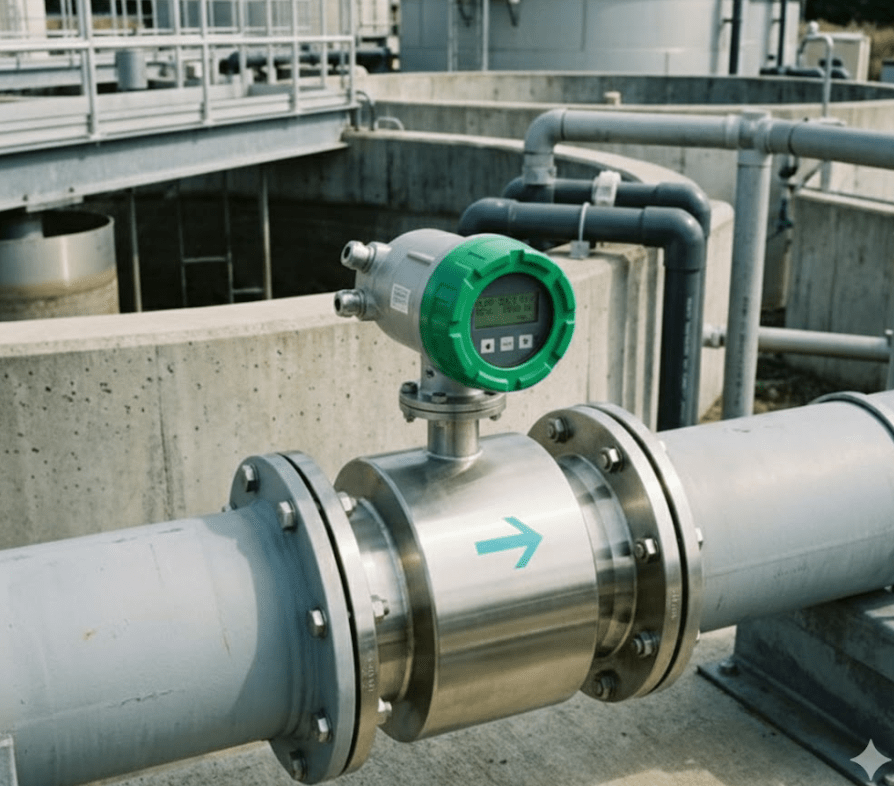
Understanding the K-factor is essential for accurate flow measurement and calibration in industrial applications.
The K-factor in magnetic flow meters represents the number of electrical pulses generated per unit volume of fluid flow (typically pulses/gallon or pulses/liter), serving as the critical calibration constant that converts the meter’s raw signal into actual flow rate measurements.
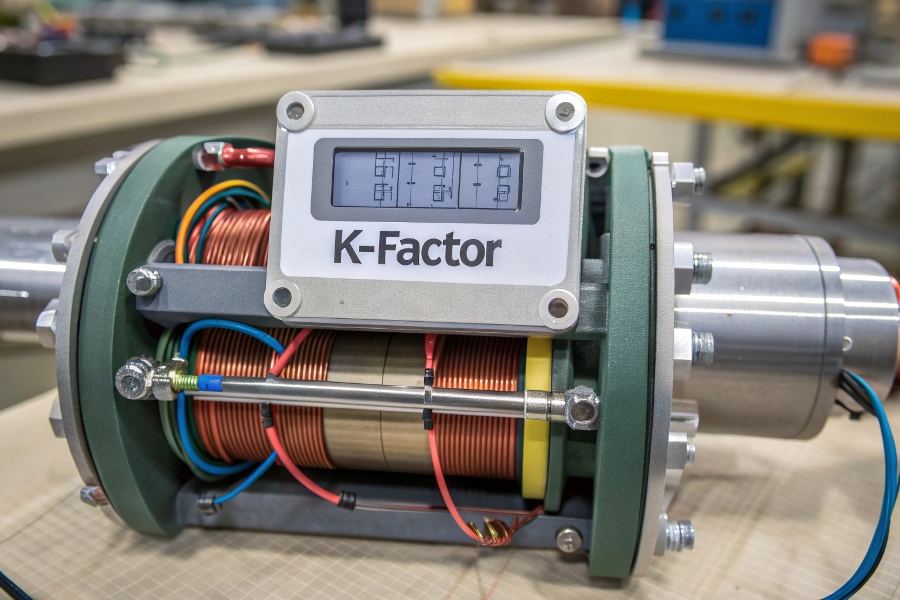
Magnetic Flow Meter Components
With years of providing flow solutions globally, I’ll explain these key concepts clearly.
What Is the K-Factor of a Magnetic Flow Meter?
This calibration constant defines the meter’s measurement characteristics.
For magnetic flow meters specifically, the K-factor relates the induced voltage (measured in millivolts) to the actual flow velocity (m/s) according to Faraday’s Law of Electromagnetic Induction – typically expressed in mV/(m/s), making it different from traditional pulse-output K-factors in other meter types.
These technical details matter significantly:
Magnetic Flow Meter K-Factor Components
| Component | Role in K-Factor | Typical Value Range | Impact on Measurement |
|---|---|---|---|
| Magnetic Field Strength | Directly proportional | 0.05-0.5 Tesla | Stronger field = higher signal |
| Electrode Spacing | Inverse relationship | Matches pipe diameter | Wider spacing = lower output |
| Fluid Conductivity | Minimum threshold required | ≥5 μS/cm | Below threshold = no signal |
| Pipe Diameter | Affects volumetric scaling | DN15-DN3000 | Larger pipes need adjustment |
What Is the K-Factor of a Mag Flow Meter Calibration?
Calibration transforms raw signals into accurate measurements.
In calibration terms, the K-factor is the determined proportionality constant that adjusts the meter’s output to match known reference flow rates during calibration procedures – typically established using master meters or weigh tanks in certified flow labs.

Flow Meter Calibration Process
This process ensures measurement accuracy:
Calibration K-Factor Determination
| Method | Process | Accuracy | Typical Applications |
|---|---|---|---|
| Gravimetric | Measures mass over time | ±0.1% | Custody transfer meters |
| Volumetric | Measures known volume | ±0.25% | Process control meters |
| Master Meter | Compares to reference | ±0.2% | Field calibrations |
| Pipe Prover | Measures displaced volume | ±0.05% | Large diameter meters |
What Is the AK Factor for a Flow Meter?
This advanced concept optimizes measurement.
The AK-factor (Adjustment K-factor) is a correction multiplier applied to the base K-factor to compensate for specific installation effects or fluid properties – typically ranging between 0.95-1.05 to fine-tune meter performance without altering its fundamental calibration.
These adjustments address real-world conditions:
Common AK-Factor Applications
| Installation Factor | Typical AK Adjustment | Reason | Verification Method |
|---|---|---|---|
| Pipe Stress | 0.98-1.02 | Mechanical deformation effects | Strain gauge measurement |
| Temperature Variation | 0.97-1.03 | Fluid density changes | Temperature compensation |
| Flow Profile | 0.96-1.04 | Non-ideal velocity distribution | Flow conditioning |
| Electrical Noise | 0.99-1.01 | Signal interference | Grounding verification |
What Is the K-Factor in an Energy Meter?
Energy measurement uses similar principles differently.
In energy meters (thermal/electrical), the K-factor represents the energy equivalent per pulse (e.g., kWh/pulse or BTU/pulse) – unlike flow meters where it’s pulses per volume unit – converting pulse counts directly into energy consumption measurements.
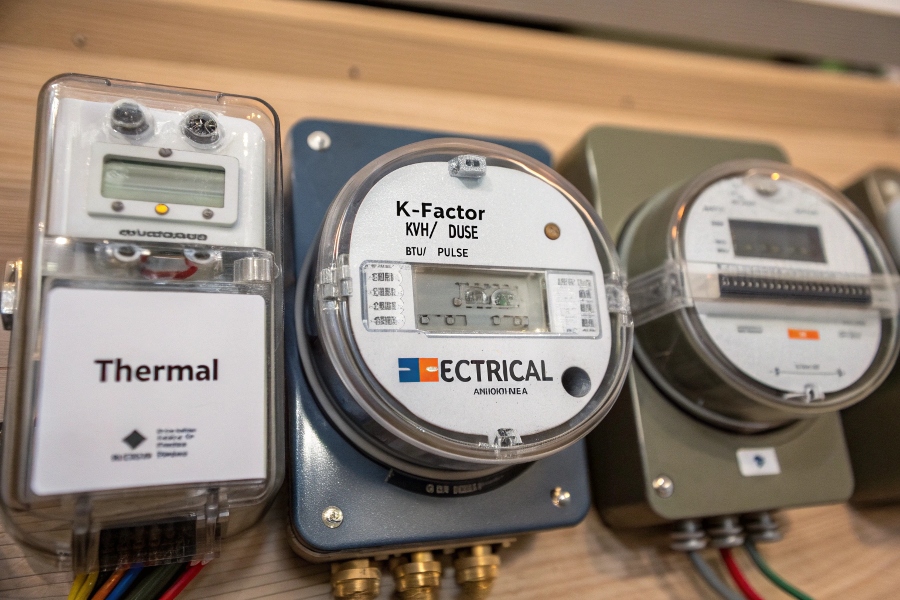
Energy Meter K-Factor
Key differences between flow and energy applications:
K-Factor Comparison: Flow vs Energy Meters
| Characteristic | Magnetic Flow Meter K-Factor | Energy Meter K-Factor | Measurement Focus |
|---|---|---|---|
| Units | mV/(m/s) or pulse/liter | kWh/pulse or BTU/pulse | Volume vs energy |
| Physical Basis | Faraday’s Law | Energy conversion constants | Velocity vs consumption |
| Adjustment Purpose | Flow calibration | Energy tariff calculations | Process vs billing |
| Typical Range | 0.5-5.0 mV/(m/s) | 1-1000 pulses/kWh | Industrial scales |
| Stability | ±0.1% over 1 year | ±0.5% over 5 years | Regular recalibration |
Conclusion
The K-factor serves as the essential bridge between a magnetic flow meter’s raw signals and usable flow measurements, with specific variants (AK-factor) addressing practical installation challenges. Understanding these concepts ensures proper meter selection, installation, and calibration for accurate process measurements.